
Research · Combat Sports Injury Prevention
Shoulders, Hips, and Ankles: What the Evidence Says About Warming Up for Combat Sports
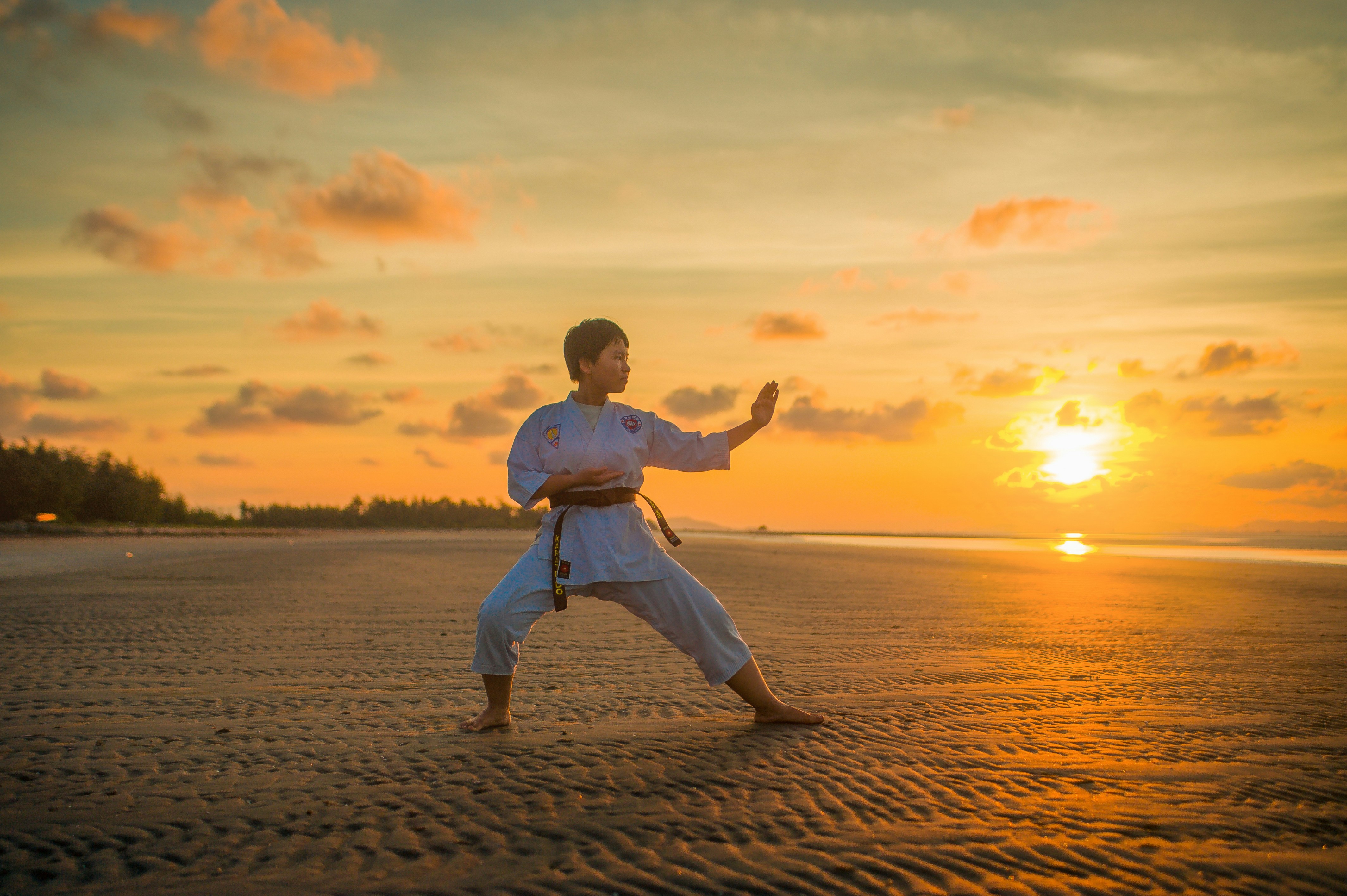
Walk into most striking or grappling gyms before class and the warm-up looks the same everywhere: a slow jog or jump rope, a round of arm circles and toe touches, maybe some static stretching held out of habit, then straight into pads, drilling, or live rounds. It raises heart rate and looks busy, but it isn't built around what actually tears, sprains, or dislocates in the sport being practiced. That gap matters more here than almost anywhere else in athletics, because striking and grappling load the shoulder, hip, and ankle in genuinely unusual ways — a rear-leg roundhouse asks the standing hip and ankle to rotate and absorb force while the fighter is off-balance on one leg; a throw or a scramble asks the shoulder to hold a stabilized position under load through a range of motion nobody trains in an ordinary gym session.
The honest starting point is that research built specifically inside a Muay Thai, Krav Maga, Brazilian Jiu-Jitsu, or judo gym to test whether a particular warm-up lowers injury rates is thin. It exists — more than most coaches assume — but it's a small literature next to the decades of trials run on footballers and handball players. Where this piece draws on that larger team-sport evidence base rather than a combat-sport trial, it says so plainly: a result from a soccer pitch doesn't automatically transfer to a judo mat just because a warm-up "sounds similar."
What Actually Gets Hurt Should Decide What You Warm Up
Start with where the injuries actually land — it's a different map depending on whether the sport is decided by strikes or by control. Striking-dominant sports like Muay Thai concentrate injury on the extremities more than people expect: a survey of 195 professional and amateur fighters found 55.4% reported an injury in their most recent fight, and the extremities — not the head — accounted for the largest single share, close to 58% of all reported injuries.1 Grappling-dominant sports tell a related but distinct story. A 2024 integrative systematic review of jiu-jitsu injury epidemiology found the knee and the chest and rib region were the two most commonly injured sites, with the shoulder joint close behind — a pattern the review's authors link to guard passing, framing, and the sustained joint-locking positions unique to submission grappling.2 Judo's own injury surveillance data, gathered as the evidence base behind a dedicated judo injury-prevention programme, found fingers were the single most common site at 30%, followed by the knee at 26%, the shoulder at 22%, and the ankle at 14% — with finger injuries excluded from that programme's design specifically because of how comparatively minor they tend to be.3
Where injury actually concentrates differs by combat sport style — the argument for a warm-up built around a discipline's specific joints, not a generic template.
That pattern is the case for a combat-sport warm-up looking different from a generic one. Raising heart rate and stretching the hamstrings does not address the shoulder capsule that takes repeated external-rotation load from underhooks and break-falls, the hip that has to internally rotate and decelerate a kicking leg mid-flight, or the ankle that absorbs an awkward landing off a sprawl or a missed sweep. The injury data says where a warm-up's attention should go; the harder question, addressed below, is how much direct evidence exists that doing something about it actually changes the injury rate.
The Honest Limit of the Evidence
The most rigorous review of neuromuscular warm-up strategies for injury prevention — a 2012 systematic review in BMC Medicine that searched seven databases and screened down to nine controlled trials — found real, meaningful reductions in lower-limb injury risk from structured warm-up programs.4 Read the underlying trials, though, and the populations are footballers, basketball players, and military recruits, overwhelmingly women's and youth teams at that. Combat sports are essentially absent from that literature. That's not a reason to ignore the finding — a warm-up strategy that reliably lowers ankle-sprain and lower-limb injury risk in young footballers is plausibly doing something similar for an athlete loading the same joints in judo randori or Muay Thai sparring — but it is a reason to be precise about what is direct evidence and what is reasonable, evidence-informed extrapolation.
What the FIFA 11+ Family Actually Shows, and Why It's Relevant Here
The single best-studied structured warm-up in sport is the FIFA 11+, a roughly 20-minute neuromuscular program of running, strength, plyometric, and balance exercises. A 2025 systematic review of five randomized controlled trials found teams performing it saw meaningful reductions in overall and lower-extremity injury incidence versus a traditional warm-up, with preventive effects ranging from roughly 30% to 46%.5 A separate 2025 systematic review and meta-analysis focused specifically on ankle injuries found a pooled 33% reduction in ankle injury incidence among players using the program.6 Both reviews point to the same underlying mechanism: the program works by improving neuromuscular control, trunk and hip stability, eccentric strength, and dynamic alignment during high-risk movements like cutting and landing — qualities that also plausibly govern whether a fighter's standing leg holds up under a checked kick, or a grappler's knee survives an awkward scramble.
That mechanism is the bridge combat-sport coaches are reasonably crossing when they borrow from this literature, and at least one study has tested the bridge directly rather than assuming it holds. A 2026 randomized crossover study put sixteen youth judo athletes through both a FIFA 11+ Kids warm-up and their sport's own traditional judo-specific warm-up, then tested explosive and functional performance after each.13 The generic, football-derived warm-up produced significantly better vertical jump and anaerobic power output than the athletes' own established judo warm-up — a performance result, not an injury-outcome one, from a single small trial, but real evidence that the neuromuscular-warm-up template, not just its football-specific packaging, does legitimate work inside a combat sport it was never designed for.
The Two Trials Actually Built for a Combat Sport
Two research groups have gone further and tested a warm-up built from the ground up for one specific combat sport — and their results disagree instructively.
The first is IPPON, a judo-specific warm-up developed in the Netherlands through a structured, multi-step process combining the injury surveillance data above with expert consultation and pilot testing.3 The finished program runs 10 to 15 minutes barefoot on the mat at the start of training, drawing 12 exercises from three categories — flexibility and agility, balance and coordination, and strength and stability — each with three difficulty levels, led by the trainer because judo culture makes trainer-led delivery far more likely to actually happen. A cluster-randomized controlled trial of 269 recreational judo athletes tested it against a normal warm-up over 16 to 26 weeks. Mean injury prevalence came out at 23% in the IPPON group versus 28% in control — a trend in the right direction, but not statistically significant.8 The trial's own authors were candid about what that null result did and didn't mean: despite failing to significantly cut injury prevalence, every trainer and 70% of athletes rated the program a success, and adherence was high enough that the authors still recommend it as a useful alternative to a standard judo warm-up.
The second is Wrestling+, built for freestyle wrestling and tested in a 2025 two-arm randomized controlled trial of 80 cadet wrestlers across a full six-month season.9 The program is more involved than IPPON — three parts and 14 exercises in a fixed order, progressing through three difficulty levels across 72 sessions, three times a week — built around shoulder stretches and bridges, a core-focused middle section, and wrestling-simulated movement. The result was not a trend. Injuries fell 58% overall against control, injury burden (days lost per 1,000 training hours) fell 63%, and the reductions held up joint by joint — ankle down 71%, spine down 71%, shoulder down 63%, knee down 60% — alongside large effect-size gains in neuromuscular control and dynamic balance.
Two combat-sport-specific warm-up trials, two very different outcomes — a reminder that intent alone doesn't guarantee results; dose, specificity, and delivery do.
The two trials are less a contradiction than a lesson in what separates a warm-up that works from one that merely sounds right. Wrestling+ ran longer, trained harder — three sessions weekly across a full season rather than a minimum of twice — progressed through difficulty levels in fixed sequence, and built its final section directly out of the sport's actual shooting and sprawling positions rather than general balance drills. None of that proves IPPON's exercise selection was wrong; a null result of this size can also reflect underpowered numbers, given the trial's own authors still endorsed the program on adherence and experience grounds. But it's a genuinely useful, unglamorous finding for anyone designing a warm-up.
Good intentions and a sport-specific label aren't enough on their own. Dosage, exercise specificity, and consistent delivery are what separated a warm-up that cut injuries by more than half from one that only moved the needle without reaching significance.
Priming the Shoulder Before It Takes a Throw or a Frame
No published trial has tested a dedicated shoulder-activation warm-up in grapplers directly, so this section is extrapolation, flagged as such. The closest direct evidence comes from a 2017 cluster-randomized controlled trial in 660 elite handball players, a throwing sport loading the rotator cuff and scapular stabilizers through high volumes of forceful, extreme-range-of-motion movement each session.7 A five-exercise program targeting internal and external rotation strength, scapular muscle strength, kinetic-chain coordination, and thoracic spine mobility — built into the team's own warm-up, three times a week across a season — measurably reduced overuse shoulder injury risk. The mechanism the authors credit is straightforward: the shoulder fails less often when the muscles that decelerate and stabilize it through an extreme range of motion have been specifically primed for that job, not just generally warmed by a jog.
A grappler's shoulder isn't loaded by throwing a ball, but the underlying demand — sustained, forceful loading through end-range external rotation, repeated in the underhook, the framing hand, and the arm that breaks a fall — shares enough mechanical signature that the same category of exercise is a reasonable, if unproven, borrow. What the evidence doesn't support is assuming a few arm circles substitute for it; the handball program is specific rotator-cuff and scapular work, not general mobility.
Hip Mobility and the Kick: What Actually Loosens vs. What Actually Powers
For the striking side of combat sports, the evidence splits cleanly into two different questions that get conflated constantly: what loosens the hip enough to kick safely through range, and what actually powers the kick once it's thrown.
On the first question, a widely cited 2011 review of the acute effects of stretching on performance found that static stretching held for longer durations, done immediately before explosive activity, carries a real, dose-dependent risk of temporarily reducing strength, power, and reaction time — though the effect is negligible for holds under roughly 30 to 45 seconds.10 The review's practical recommendation is a warm-up built from submaximal aerobic work, followed by dynamic — not static — stretching through large ranges of motion, finished with sport-specific movement at rising intensity. For a kicking hip, that favors controlled leg swings and dynamic range-of-motion drills over a static hip-flexor stretch held for a minute before sparring.
On the second question — what actually adds power to the kick — two small studies point to loading the specific movement pattern rather than just moving it. A 2018 study in trained martial artists found that roundhouse kicks against elastic-band resistance in the warm-up produced a measurable increase in kicking foot velocity on the very next unresisted kick, a postactivation-potentiation effect from loading the exact pattern about to be used.11 A 2023 study in trained Muay Thai fighters found a heavier stimulus — a near-maximal squat, followed by five to eight minutes of rest — produced significant increases in both roundhouse and teep kick striking power.12 Both are performance, not injury, studies, and the heavy-squat protocol is impractical before a normal class. But together they point toward the same idea as the resistance-band study: a hip already moved through the kicking pattern under some load, immediately before sparring, is doing something different — and probably safer — than one going from a static stretch straight into a full-speed kick with no rehearsal in between.
Neuromuscular Readiness Immediately Before Sparring
Structuring all of this into something a coach can actually run is where the RAMP framework — Raise, Activate, Mobilize, Potentiate, described by strength coach Ian Jeffreys in 2007 — earns its place.14 It isn't itself a tested injury-prevention protocol; it's an organizing structure that sequences the evidence above in the order it actually applies: raise heart rate and tissue temperature first, activate the specific stabilizers a discipline relies on — shoulder external rotators for a grappler, hip and ankle stabilizers for a kicker — mobilize those same joints dynamically through the ranges the sport demands, and only then potentiate: sport-specific, rising-intensity movement immediately before live sparring, whether resisted kicks, shadow drilling at increasing speed, or controlled partner contact rehearsing the exact positions about to be tested live. The crossover trial described earlier is a useful proof of concept for this structure — a generic neuromuscular template, not bespoke to the sport, still measurably outperformed a sport's own traditional warm-up when it followed roughly this logic.
What This Actually Supports
No single validated warm-up exists for combat sports the way the FIFA 11+ exists for football — that gap is real, worth naming rather than papering over with confident advice borrowed wholesale from a different sport. What the evidence that does exist consistently supports is narrower: warming up around the joints a discipline's own injury data implicates, not a generic template; dynamic rather than prolonged static stretching before explosive work; targeted activation of the rotator cuff and scapular stabilizers for anyone framing, underhooking, or breaking falls repeatedly; and a final, sport-specific potentiation phase rehearsing the actual kicking, throwing, or shooting pattern under some load before it's thrown for real. The clearest direct result in the whole literature — Wrestling+'s 58% reduction across a full season — didn't come from a clever new exercise. It came from real dose, real specificity to the sport's actual positions, and real consistency of delivery. That, more than any single drill, is the part worth taking seriously.
Sources
- Strotmeyer S Jr, Coben JH, Fabio A, Songer T, Brooks M. "Epidemiology of Muay Thai Fight-Related Injuries." Injury Epidemiology 3:30, 2016. pmc.ncbi.nlm.nih.gov/articles/PMC5149460.
- Santos SP, Soares HHP, Perez Neto S, et al. "Epidemiology of Injuries and Their Implications in Jiu-Jitsu Practitioners: An Integrative Systematic Review." Revista Brasileira de Ortopedia 59(3):e364–e371, 2024. pmc.ncbi.nlm.nih.gov/articles/PMC11193589.
- von Gerhardt AL, Vriend I, Verhagen E, Tol JL, Kerkhoffs GMMJ, Reurink G. "Systematic Development of an Injury Prevention Programme for Judo Athletes: The IPPON Intervention." BMJ Open Sport & Exercise Medicine 6(1):e000791, 2020. pmc.ncbi.nlm.nih.gov/articles/PMC7534731.
- Herman K, Barton C, Malliaras P, Morrissey D. "The Effectiveness of Neuromuscular Warm-up Strategies, That Require No Additional Equipment, for Preventing Lower Limb Injuries During Sports Participation: A Systematic Review." BMC Medicine 10:75, 2012. pmc.ncbi.nlm.nih.gov/articles/PMC3408383.
- Patel P, Shah M. "The Impact of the FIFA 11+ Injury Prevention Program on Injury Incidence in Football Athletes: A Systematic Review of Randomized Controlled Trials." Cureus, 2025. doi:10.7759/cureus.100463. cureus.com/articles/451161.
- Eser C, Bıyıklı T, Byrne PJ, Duggan JD, Esformes JI, Moody JA. "The Impact of the FIFA 11+ Neuromuscular Training Programme on Ankle Injury Reduction in Football Players: A Systematic Review and Meta-Analysis." Muscles 4(3):30, 2025. pmc.ncbi.nlm.nih.gov/articles/PMC12371935.
- Andersson SH, Bahr R, Clarsen B, Myklebust G. "Preventing Overuse Shoulder Injuries Among Throwing Athletes: A Cluster-Randomised Controlled Trial in 660 Elite Handball Players." British Journal of Sports Medicine 51(14):1073–1080, 2017. doi.org/10.1136/bjsports-2016-096226.
- von Gerhardt AL, Reurink G, Kerkhoffs GMMJ, Verhagen E, Krabben K, Mooren J, Gal JSI, Brons A, Joorse R, van den Broek B, Kemler E, Tol JL. "Effectiveness of a Judo-Specific Injury Prevention Programme: A Randomised Controlled Trial in Recreational Judo Athletes." British Journal of Sports Medicine 57(8):450–456, 2023. pubmed.ncbi.nlm.nih.gov/36717214.
- Bayati R, Shamsi Majelan A, Zarei H. "Effects of the Wrestling+ Injury Prevention Program in Freestyle Wrestlers: A Two-Arm Randomized Controlled Trial." Journal of Orthopaedic Surgery and Research 20:486, 2025. pmc.ncbi.nlm.nih.gov/articles/PMC12087162.
- Behm DG, Chaouachi A. "A Review of the Acute Effects of Static and Dynamic Stretching on Performance." European Journal of Applied Physiology 111(11):2633–2651, 2011. pubmed.ncbi.nlm.nih.gov/21373870.
- Aandahl HS, von Heimburg E, van den Tillaar R. "Effect of Postactivation Potentiation Induced by Elastic Resistance on Kinematics and Performance in a Roundhouse Kick of Trained Martial Arts Practitioners." Journal of Strength and Conditioning Research 32(4):990–996, 2018. pubmed.ncbi.nlm.nih.gov/29194182.
- Brown L, Doyle G, Bruce-Low S, Domingos S, Anthony K, Rowan F, Galbraith A. "Postactivation Potentiation for Muay Thai Kicking Performance." Journal of Strength and Conditioning Research 37(10):2032–2037, 2023. doi.org/10.1519/JSC.0000000000004499.
- Mor H, Şar H, Arslan T, et al. "Acute Effects of the FIFA 11+ Kids Warm-up Program Compared With a Judo-Specific Warm-up on Explosive and Functional Performance in Youth Judo Athletes: A Randomized Crossover Study." BMC Sports Science, Medicine and Rehabilitation 18:318, 2026. link.springer.com/article/10.1186/s13102-026-01751-4.
- Jeffreys I. "Warm-up Revisited: The RAMP Method of Optimizing Warm-ups." Professional Strength and Conditioning 6:12–18, 2007. researchgate.net/publication/280945961.
Want this applied to your own program, team, or school? Free 20-minute consult, no obligation.
Book a free consult →