
Research · Female Athlete Physiology
Female Athletes, ACL Risk, and the Menstrual Cycle: What the Research Actually Shows
Two claims about female athletes come up constantly in youth and amateur sport, and they don't rest on remotely the same amount of evidence. The first — that female athletes tear their ACL at a dramatically higher rate than male athletes in the same sport — is one of the more replicated findings in sports medicine, backed by decades of injury-registry data and a real, if incomplete, mechanistic explanation. The second — that training and nutrition should be restructured week by week around where an athlete sits in her menstrual cycle — is one of the most confidently marketed ideas in women's sport science right now, and one of the shakiest once the actual systematic reviews are read rather than summarized. Treating both claims with the same confidence does athletes a disservice on both counts. Here is what the evidence for each one actually supports.
How large is the ACL gap, really?
The 2008 International Olympic Committee consensus statement on non-contact ACL injuries in female athletes — a review by a multidisciplinary panel of ACL researchers and clinicians, drawing on national injury registries and controlled biomechanics studies, published in the British Journal of Sports Medicine1 — remains the reference point most later work builds on, and its numbers are stark. High-school basketball players tore their ACL at roughly a 4.5-to-1 ratio of female to male; college basketball, roughly 3.6-to-1. Female soccer players were injured at about double the rate of male players. In elite handball, women sustained 2.29 ACL injuries per 1,000 match-hours against 0.31 for men. Competitive female alpine skiers were injured at roughly twice the rate of male skiers.
Newer data hasn't closed that gap; if anything, it has confirmed how consistent it is. A 2025 overview in the Journal of Functional Morphology and Kinesiology, pooling results from 51 separate meta-analyses of ACL injury incidence2, put modern basketball incidence at roughly 3.7 to 4.6 times higher in women than men, and soccer at 2.7 to 8 times higher depending on level and dataset. Across the sports it covered, the review's overall judgment landed on a two-to-sixfold higher risk for female athletes generally — a range wide enough to reflect real variation by sport, but nowhere close to parity in any of them.
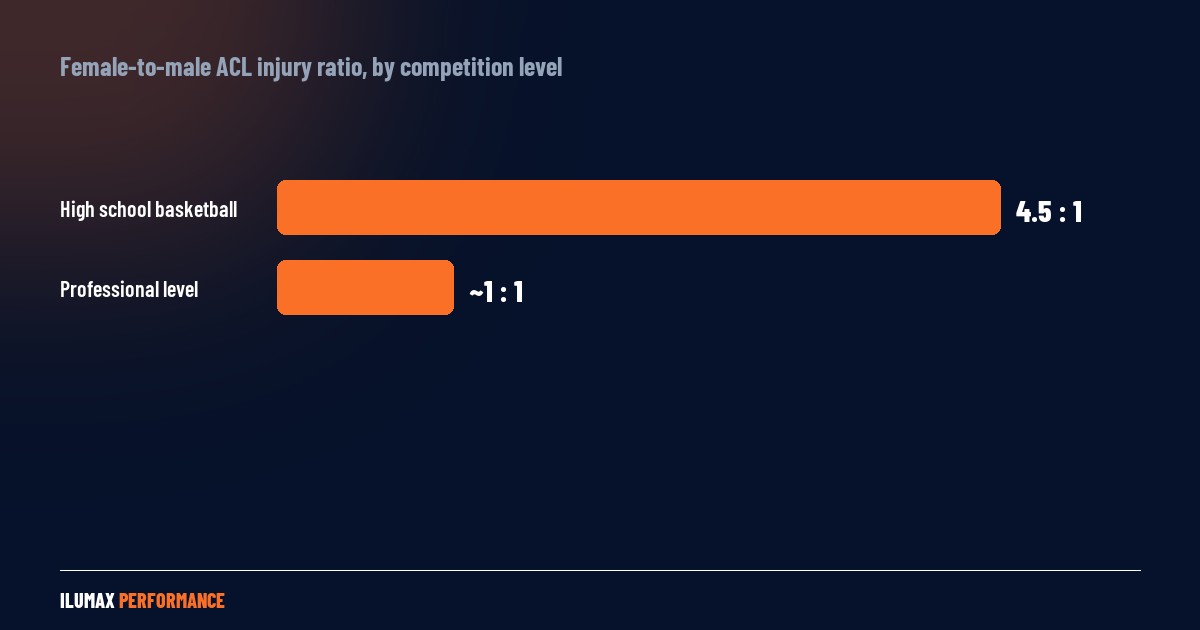
Female-to-male ACL injury ratio in basketball, high school through professional — per Renstrom et al., IOC consensus statement, 2008.
That last figure matters for anyone working with adolescents specifically: the disparity is largest in exactly the population still developing the movement patterns that appear to drive it, and it narrows as those patterns are trained, selected for, or simply mature.
What's actually driving it: a movement pattern, not just anatomy
The IOC statement's own account of the mechanism centers on how female athletes land and change direction, not on ligament size or bone shape alone. Compared with male athletes performing the same cutting or landing tasks, female athletes in the cited research tended to land with straighter knees — less knee flexion absorbing the impact — combined with more inward collapse of the knee relative to the hip and foot. The panel also described a quadriceps-dominant activation pattern: female athletes in several of the underlying studies fired their quadriceps at close to double the muscle activity of male athletes performing the same movement, while hamstring activation — the muscle group that helps resist the forward shear force on the ACL — ran at roughly half the level seen in men. Add reduced trunk and hip control on landing, and the combination raises strain on a ligament that isn't built to resist it.
A more recent, tightly controlled meta-analysis in Sports Medicine – Open, pooling 17 studies and 451 athletes on change-of-direction biomechanics3, confirmed several of these differences with measurable effect sizes: female athletes showed significantly less peak knee flexion and significantly greater knee abduction at the moment their foot hit the ground, along with differences in hip rotation. But the same analysis found no significant sex difference in the actual multiplanar forces loading the knee joint during those movements. That is a genuinely important gap in the evidence, not a footnote: the visible landing pattern differs in the direction injury theory predicts, but this dataset could not confirm that the difference translates into a measurably higher mechanical load on the ligament itself. The link between a riskier-looking pattern and an actually riskier one is plausible and consistent with the injury data, but it isn't yet a fully closed scientific loop.
Where hormones fit — and where the evidence gets shakier
The 2008 IOC statement also raised a hormonal hypothesis: that estrogen and relaxin fluctuations across the menstrual cycle affect ligament laxity, and that ACL injuries might cluster in specific cycle phases as a result. Several of the studies it drew on pointed to the preovulatory phase as overrepresented, but the panel's own reading was that the pattern was inconsistent across studies and poorly understood mechanistically, since much of the underlying research relied on athletes' own recall of cycle timing rather than confirmed hormone testing — a weak way to assign a phase.
Later work hasn't tightened that picture. A 2023 systematic review in PLOS ONE that specifically re-examined menstrual cycle phase against ACL injury risk surrogates — knee laxity and neuromuscular control4 — found only seven studies rigorous enough to include out of 418 screened, and rated the overall evidence quality as very low. Four of those seven found no meaningful difference between cycle phases at all; two pointed toward the mid-luteal phase rather than the preovulatory phase the earlier hypothesis had emphasized. The review's own conclusion was that it remains genuinely unresolved whether, or when, a particular phase of the cycle raises ACL injury risk. The hormonal mechanism is biologically plausible and worth continued study — but as a basis for telling an individual athlete which week she's at elevated risk, the evidence isn't there yet.
What actually reduces the risk — and the age window that matters most
The intervention with the strongest evidence behind it isn't diagnostic at all — it's neuromuscular training: structured programs of plyometrics, landing-mechanics coaching, and strength work aimed directly at the movement pattern the biomechanics research flags, rather than at anything hormonal. A meta-analysis in the American Journal of Sports Medicine, pooling 14 controlled trials5, found this style of training cut ACL injury risk by 72% in athletes under 18 — a large, statistically robust effect. In athletes over 18, the same style of program produced only a 16% reduction, and that result was not statistically significant. Broken down further, athletes aged 14 to 18 saw close to the full 72% effect; 18-to-20-year-olds saw a 52% reduction; athletes over 20 saw essentially none.
The authors' own reading of that pattern is that there is a window, roughly through mid-to-late adolescence, before neuromuscular deficits and movement patterns fully set, during which this kind of training does the most to change an athlete's actual risk. Starting later doesn't make the training pointless, but the same effort produces a measurably smaller return once that window has mostly closed — a strong argument for building landing-mechanics work into youth programs early, rather than waiting for a growth spurt or a first injury to prompt it.
The other big claim: training around the menstrual cycle
Separate from ACL risk, a large and growing amount of content aimed at female athletes argues that strength training itself should be restructured phase by phase — heavier loading in one part of the cycle, lighter or different training in another — on the premise that hormonal shifts meaningfully change how much force a woman can produce or how well she recovers. That is a stronger, more specific claim than "the menstrual cycle affects the body somehow," and it deserves to be checked against the same standard as the ACL research above.
An umbrella review in Frontiers in Sports and Active Living in 2023, which pooled the existing meta-analyses and systematic reviews on menstrual cycle phase and resistance training6, found no consistent influence of cycle phase on either single-session strength performance or on the strength and hypertrophy gained from a training program over time. The authors traced much of the disagreement in the underlying literature to weak methodology: many older studies assumed every participant ovulated on day 13 of a standard 28-day cycle rather than confirming it, and one of the more common proxies for tracking ovulation — basal body temperature — lined up with an actual hormone-confirmed ovulation surge in only a minority of the cycles the review's own citations measured. Built on assumptions like that, a "phase-based" training block is functionally an ordinary training variation wearing a menstrual-cycle label.
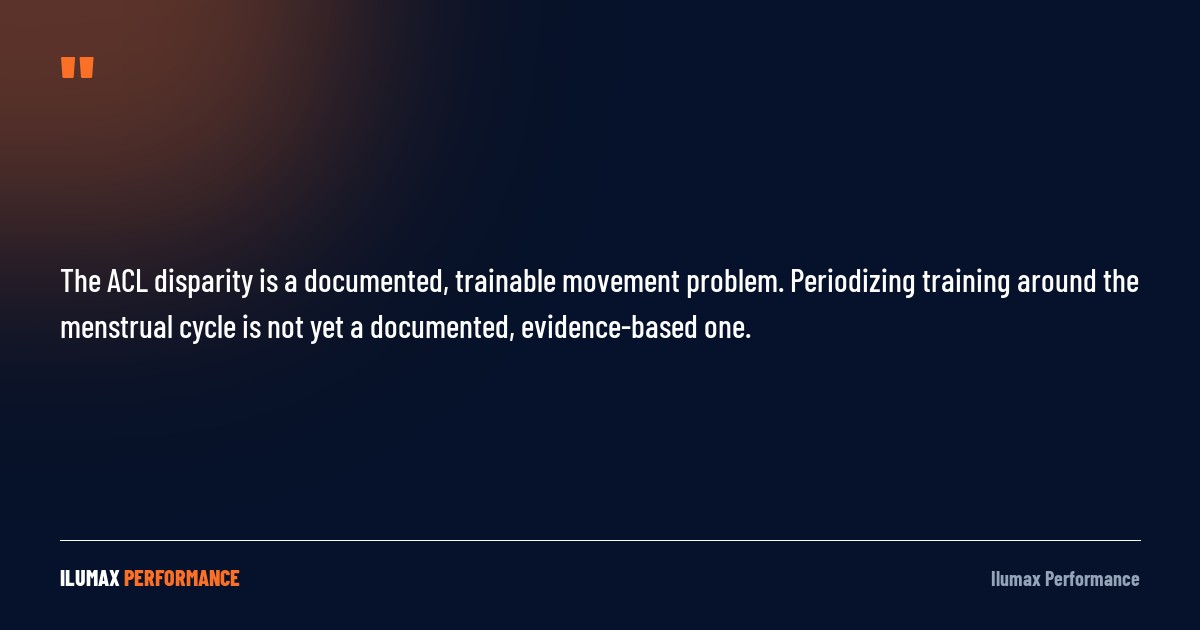
The ACL disparity is a documented, trainable movement problem. Periodizing training around the menstrual cycle is not yet a documented, evidence-based one.
A separate, more recent meta-analysis in the journal Sports, focused specifically on maximal strength across cycle phases in 22 studies and 433 total participants7, complicates a flat "no effect" verdict slightly: it did find small-to-medium statistical effects, with the early follicular phase — roughly the days immediately after menstruation begins — coming out weakest across isometric, isokinetic, and dynamic strength testing. But the authors rated their own confidence in that finding as low, for a specific and telling reason: of the 22 studies pooled, fewer than half confirmed cycle phase with an actual hormone blood test rather than counting calendar days. A small effect built mostly on unverified phase assignment isn't a foundation solid enough to hand an athlete a different program every week.
Read together, the two most rigorous recent reviews on this question land in different places — one finds no effect, the other finds a small one it doesn't fully trust — and that disagreement is itself the finding. It points to the same conclusion an honest reading of a genuinely unsettled evidence base should produce: not "the menstrual cycle definitely changes performance," and not "it definitely doesn't," but "the case for restructuring a training program around it hasn't been made yet."
What this means in practice
For ACL risk, the practical takeaway is straightforward and well-supported: landing mechanics and change-of-direction technique are gaps a program can actually close, and the evidence says the earlier in adolescence that work starts, the more of the risk it removes. That is a coaching and screening problem — assessing how an athlete lands and cuts, then training the specific pattern the research flags — rather than a reason to treat every female athlete as fragile, or to wait on a diagnostic test that doesn't yet exist.
For the menstrual cycle, the honest position sits closer to individualization than either extreme. Tracking how an athlete actually feels, performs, and recovers across her own cycle — and adjusting to her, not to a generic chart — is a reasonable, low-cost practice. Building a program's entire structure around the assumption that every woman's cycle affects her training the same predictable way is not something the current evidence, read carefully rather than summarized in a headline, actually supports.
Sources
- Renstrom P, Ljungqvist A, Arendt E, Beynnon B, Fukubayashi T, Garrett W, Georgoulis T, Hewett TE, Johnson R, Krosshaug T, Mandelbaum B, Micheli L, Myklebust G, Roos E, Roos H, Schamasch P, Shultz S, Werner S, Wojtys E, Engebretsen L. "Non-Contact ACL Injuries in Female Athletes: An International Olympic Committee Current Concepts Statement." British Journal of Sports Medicine 42(6):394–412, 2008. pmc.ncbi.nlm.nih.gov/articles/PMC3920910.
- Martinez-Calderon J, Infante-Cano M, Matias-Soto J, Perez-Cabezas V, Galan-Mercant A, Garcia-Muñoz C. "The Incidence of Sport-Related Anterior Cruciate Ligament Injuries: An Overview of Systematic Reviews Including 51 Meta-Analyses." Journal of Functional Morphology and Kinesiology 10(2):174, 2025. pmc.ncbi.nlm.nih.gov/articles/PMC12101161.
- Donelon TA, Edwards J, Brown M, Jones PA, O'Driscoll J, Dos'Santos T. "Differences in Biomechanical Determinants of ACL Injury Risk in Change of Direction Tasks Between Males and Females: A Systematic Review and Meta-Analysis." Sports Medicine – Open 10:37, 2024. pmc.ncbi.nlm.nih.gov/articles/PMC10984914.
- Dos'Santos T, Stebbings GK, Morse C, Shashidharan M, Daniels KAJ, Sanderson A. "Effects of the Menstrual Cycle Phase on Anterior Cruciate Ligament Neuromuscular and Biomechanical Injury Risk Surrogates in Eumenorrheic and Naturally Menstruating Women: A Systematic Review." PLOS ONE 18(1):e0280800, 2023. journals.plos.org/plosone/article?id=10.1371/journal.pone.0280800.
- Myer GD, Sugimoto D, Thomas S, Hewett TE. "The Influence of Age on the Effectiveness of Neuromuscular Training to Reduce Anterior Cruciate Ligament Injury in Female Athletes: A Meta-Analysis." American Journal of Sports Medicine 41(1):203–215, 2013. DOI: 10.1177/0363546512460637.
- Colenso-Semple LM, D'Souza AC, Elliott-Sale KJ, Phillips SM. "Current Evidence Shows No Influence of Women's Menstrual Cycle Phase on Acute Strength Performance or Adaptations to Resistance Exercise Training." Frontiers in Sports and Active Living 5:1054542, 2023. frontiersin.org/journals/sports-and-active-living/articles/10.3389/fspor.2023.1054542.
- Niering M, Wolf-Belala N, Seifert J, Tovar O, Coldewey J, Kuranda J, Muehlbauer T. "The Influence of Menstrual Cycle Phases on Maximal Strength Performance in Healthy Female Adults: A Systematic Review with Meta-Analysis." Sports 12(1):31, 2024. pmc.ncbi.nlm.nih.gov/articles/PMC10818650.
Want this applied to your own program, team, or school? Free 20-minute consult, no obligation.
Book a free consult →