Research · Youth Football Development
Small-Sided Games, Load Monitoring, and the FIFA 11+: What's Actually Changed in Youth Football Development
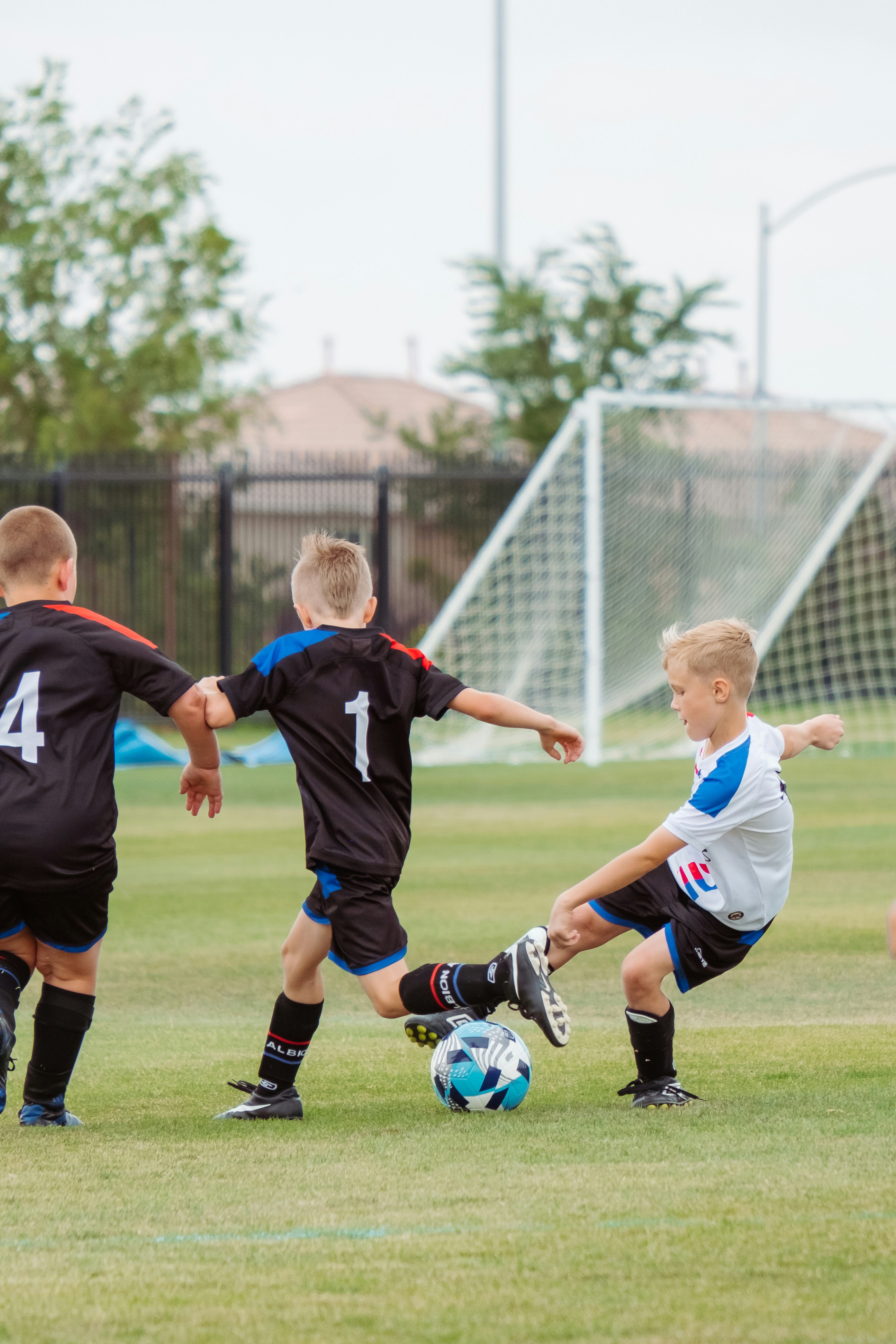
Ask what "good" youth football coaching looks like and a decade-old template still comes up first: technical drills in lines, an adult-sized warm-up, and a season built around winning the age-group league. FIFA's own guidance and Singapore's national governing body, the Football Association of Singapore (FAS), have both been moving away from that template — not as a rebrand, but as documented programme design. A physical-literacy foundation ahead of sport-specific technique, small-sided games as the default teaching method rather than an occasional break from drilling, a standardised injury-prevention warm-up FIFA has spent two decades building an evidence base for, and GPS-based load monitoring now written into an actual academy partnership in Singapore. None of this is aspirational language pulled from a strategy deck. Each element below is a program, a page, or a published trial that currently exists and was checked directly for this piece.
FIFA's 11+ family: injury prevention as required infrastructure, not an add-on
The clearest example of FIFA turning research into standard practice is the 11+ programme, developed by F-MARC (the FIFA Medical Assessment and Research Centre). It replaces a generic warm-up with a structured, three-part neuromuscular routine — roughly 25 minutes, with three progressive difficulty levels — built around running exercises, strength, balance, and plyometric drills rather than static stretching.1 A 2025 systematic review of randomised controlled trials in Cureus pooled the outcome data: youth male teams saw a 41% reduction in overall injury incidence, collegiate male athletes a 46% reduction in total injuries, with reported effects across youth and adult populations generally landing in the 30–46% range.2 The same review flagged the variable that actually decided the outcome in every trial it examined: "injury reduction strongly dependent on adherence; high-compliance teams benefited most." The programme's design isn't really the open question anymore — consistent execution is.
FIFA 11+ Kids is the version built specifically for children aged 7–13, developed because a program tuned for adult biomechanics doesn't automatically transfer downward. It runs about 20 minutes, recommended twice weekly, built around coordination, balance, leg-strength, core stability, and controlled-falling technique.3 A multinational cluster-randomised controlled trial published in Sports Medicine, run across youth teams in Switzerland, Germany, the Czech Republic, and the Netherlands, is the strongest evidence behind it: the intervention group saw a 48% reduction in overall injury rate, a 55% reduction in lower-extremity injuries, and a 74% reduction in severe injuries compared to teams using a standard warm-up.4 That last figure is the one worth sitting with — a warm-up, done consistently, cutting severe injuries by roughly three-quarters in the trial population.
Small-sided games become the default teaching method, not the reward at the end of practice
FIFA's own coach-education content, published through its Training Centre platform, promotes a session structure it calls Play-Practice-Play: sessions open with a small-sided game, move into focused technical repetition, then close with open play so players immediately apply what they just worked on.5 The framework's own explanation for why it's built this way is direct: "the game itself is often the best teacher." Coaches vary team size, pitch dimensions, and rules within the opening and closing game phases to keep the challenge matched to the group in front of them, and FIFA has published age-specific versions of this same structure for roughly 4–8, 8–12, and 12–15 year-olds — it's positioned as a scalable coaching methodology, not a single drill.
This isn't only a FIFA talking point. FAS's own strength-and-conditioning guidance for players describes football as "a high-intensity, intermittent, contact team sport" and states plainly that the aerobic and anaerobic conditioning, speed, agility, strength, and power it demands are "best developed through high intensity interval training, small-sided games, repeated sprints, coached speed and agility sessions and strength and power-based gym sessions."6 Small-sided games sit in that list as a named physical-development tool, not just a technical or tactical one — the same activity is being asked to do double duty as conditioning and skill work, which is precisely the efficiency argument behind why it has become the default rather than a supplement.
FIFA's talent-development approach: pathway, contact time, coaching, and welfare
FIFA's published talent-development framework organises its priorities around four areas rather than a single training method.7 The first is player pathway development — building competition structures so players compete against others at a similar stage of physical maturation, rather than skipping developmental levels because of results. The second is what FIFA describes as enhanced playing opportunities: better league structures specifically aimed at increasing "contact time," the actual hours a player trains and competes, rather than assuming more matches automatically means better development. The third is coaching development — building pathways so coaches themselves gain structured experience across different age phases rather than applying one adult-oriented style downward. The fourth is holistic player welfare: safeguarding policies, mental-health support, and formal or informal education running alongside the athletic program, not bolted on afterward.
What's notable about this framework is what it deliberately isn't: a single method or drill FIFA is exporting worldwide. It's closer to an operating system — the specific content (which small-sided game, which warm-up, which testing protocol) is left to national associations and academies to fill in, which is exactly the gap FAS's own programmes have been building out locally.
None of these threads is really a separate trend. Build the general movement foundation before the sport-specific technique, protect the tissue doing the work with a warm-up backed by its own randomised trials, and replace guesswork about training load with something measured. FIFA has been setting that direction globally — Singapore's own governing body has been the one actually building it into a local pathway.
Singapore's own pathway: Unleash the Roar!
FAS and Sport Singapore launched Unleash the Roar! in March 2021 as the national project meant to lift both grassroots participation and the elite pathway simultaneously, rather than treating them as separate problems.8 Two purpose-built centres sit at the core of the talent side of that pathway.
Junior Development Centre (ages 8–12)
The JDC is a merit-based programme for children aged roughly 8 to 12, designed to identify and develop promising young footballers through a structured programme rather than club-by-club informal scouting.8
National Development Centre (U13–U16)
Built on the JDC's foundation, the NDC takes players from 13 to 16 and is explicitly described as moulding players "for elite pathways and national representation."9 Its coaching model is deliberately player-centred: players are "coached through a self-discovery process" aimed at sharper decision-making under the pressure and intensity of higher-level football, run through a smaller-squad model intended to make the transition from training to actual match minutes more direct. The facilities behind it include all-weather pitches and a high-performance gym "equipped with sports science technology," and the programme states outright that it applies "science-based methods to track progress, build resilience, and condition players for peak performance" — video analysis, individual assessment, and evidence-based training blending physiology, biomechanics, nutrition, and psychology. Players are recruited into it from the Singapore Youth League and the National School Games, not through a closed invite list.
Load monitoring lands in Singapore's academies
GPS-based external load monitoring — tracking distance, sprint counts, accelerations, and change-of-direction volume during training and matches — has moved in the wider football world from a research tool into a routine part of professional and elite youth academy programmes, though a 2026 narrative review in the journal Sports notes that meaningful methodological inconsistency still exists across clubs in how the underlying variables are even defined and measured.10 Singapore's own academy structure has a concrete, named example of this arriving locally rather than staying a foreign concept.
Four Singapore Premier League clubs — Geylang International, Balestier Khalsa, Albirex Niigata (Singapore), and Tanjong Pagar United — partnered with FAS coaches through the Centre of Excellence programme to jointly manage their respective Under-13, Under-14, and Under-15 development teams, feeding players up from the ActiveSG Academy's 8–12 age pathway.11 The sports-science support built into that partnership is specific: strength and conditioning, video analysis, health and nutrition guidance, load monitoring, and online tracking of each player's individual development — for players aged 12 to 15, not first-team professionals. FAS General-Secretary Chew Chun-Liang framed the move as building on what was already working: "SPL clubs have done some excellent work with the COE programme, and I'm confident that this initiative will provide a tangible boost to our collective efforts."
An accreditation system, and a league to match it
FAS runs an Academy Accreditation System (AAS) that grades football academies and clubs across the country on Talent Identification, Coaching, Player Performance, Player Welfare, and Annual Assessment, awarding a tier from Level One (highest) down to Level Three (base).12 The stated intent behind the criteria is explicit about what it's optimising for: a high-quality learning environment for young players, "with an emphasis on development as opposed to winning at all costs." Accreditation isn't symbolic — it carries access to coaching courses, financial training incentives, and participation in the league structure built to sit on top of it.
That league is the Singapore Youth League (SYL), jointly run by Sport Singapore and FAS, which launched in 2024 with roughly 200 teams from 52 clubs and academies. The 2025 season scaled sharply: 316 teams, a 58% increase on the inaugural year, spread across 12 age categories — double the six offered in 2024 — with a new girls-only league of 18 teams across Under-10, Under-12, and Under-14 age groups.13 Over 6,000 young players took part, competing from February to November across roughly 15 matches per team, and the league's simultaneous kickoff set an entry in the Singapore Book of Records for the most football teams starting play at once. Scale like that only matters if it's also feeding the pathway above it, but it does at least establish that the base of the pyramid — not just the JDC/NDC talent tier — is being actively built out and measured year over year.
Where the picture is thinner
It's worth being precise about what is, and isn't, publicly documented. FAS's own strength-and-conditioning and academy pages describe the physical qualities and methods the pathway targets, and the SPL Centre of Excellence partnership names load monitoring explicitly for the 12–15 age band — but there's no public data on what share of Singapore's youth teams outside that accredited, competitive tier are actually running FIFA 11+ or 11+ Kids as their standard warm-up, or how consistently. FIFA's own systematic-review evidence is explicit that the programme's benefit is adherence-dependent, and adherence at the grassroots level — the hundreds of teams playing in the SYL below the AAS's top tiers — isn't something either FIFA or FAS has published figures on. The honest read is that the elite and near-elite pathway (JDC, NDC, AAS Level One/Two academies, SPL-linked COEs) shows genuine, specific, sports-science infrastructure. What happens in an average weekend training session at a Level Three or unaccredited club is a different question, and one the public record doesn't currently answer.
What this adds up to
Put together, the direction is consistent rather than scattered: physical literacy and general movement competence ahead of narrow technical drilling, small-sided games doing double duty as both the primary teaching method and a conditioning tool, an injury-prevention warm-up with its own randomised trial evidence rather than folklore behind it, and training load that gets measured rather than guessed at — at least at the level of the pathway built to produce Singapore's next national-team players. For a program built around individualised testing rather than a one-size template, that's the encouraging part: the direction FIFA has been setting globally, and FAS has been building locally, points at the same thing a properly run strength and conditioning programme for a young athlete should already be doing — assess where the player actually is, build the general foundation before the specialised layer, and track load with data instead of assuming a session went fine because nobody complained.
Sources
- F-MARC (FIFA Medical Assessment and Research Centre). "The 11+ — A Complete Warm-Up Programme to Prevent Injuries." f-marc.com/fifa-11.
- Patel P, Shah M. "The Impact of the FIFA 11+ Injury Prevention Program on Injury Incidence in Football Athletes: A Systematic Review of Randomized Controlled Trials." Cureus 17(12):e100463, 2025. doi.org/10.7759/cureus.100463.
- F-MARC (FIFA Medical Assessment and Research Centre). "FIFA 11+ Kids." f-marc.com/fifa-11-for-kids.
- Rössler R, Junge A, Bizzini M, et al. "A Multinational Cluster Randomised Controlled Trial to Assess the Efficacy of '11+ Kids': A Warm-Up Programme to Prevent Injuries in Children's Football." Sports Medicine 48:1493–1504, 2018. DOI: 10.1007/s40279-017-0834-8.
- FIFA Training Centre. "Ages 4–8: An Introduction to Play-Practice-Play." fifatrainingcentre.com.
- Football Association of Singapore. "Strength & Conditioning." fas.org.sg/football-science/strength-conditioning.
- FIFA. "Talent Development — Spotlight." publications.fifa.com/en/talent-development/spotlight.
- Football Association of Singapore. "Unleash the Roar! — An Aspiration to Unify Singaporeans Through Football." fas.org.sg.
- Unleash the Roar! "NDC (U13–U16)." unleashtheroar.com.sg/let-them-play/ndc-u13-u16.
- "A Call for Consensus: A Narrative Review of GPS-Based External Training Load Monitoring in Male Youth Soccer Players." Sports 14(4):152, 2026. doi.org/10.3390/sports14040152.
- Unleash the Roar! "Singapore Premier League Centres of Excellence Partner School Football Academy Programme to Strengthen Youth Development." unleashtheroar.com.sg.
- Football Association of Singapore. "Academy Accreditation." fas.org.sg/academy-accreditation.
- Unleash the Roar! "Singapore Youth League Sets Singapore Book of Records Entry for Most Football Teams Kicking Off Simultaneously." unleashtheroar.com.sg.
Want this applied to your own program, team, or school? Free 20-minute consult, no obligation.
Book a free consult →