
Research · Injury & Recovery
Osgood-Schlatter Is Not Simply Something They Grow Out Of
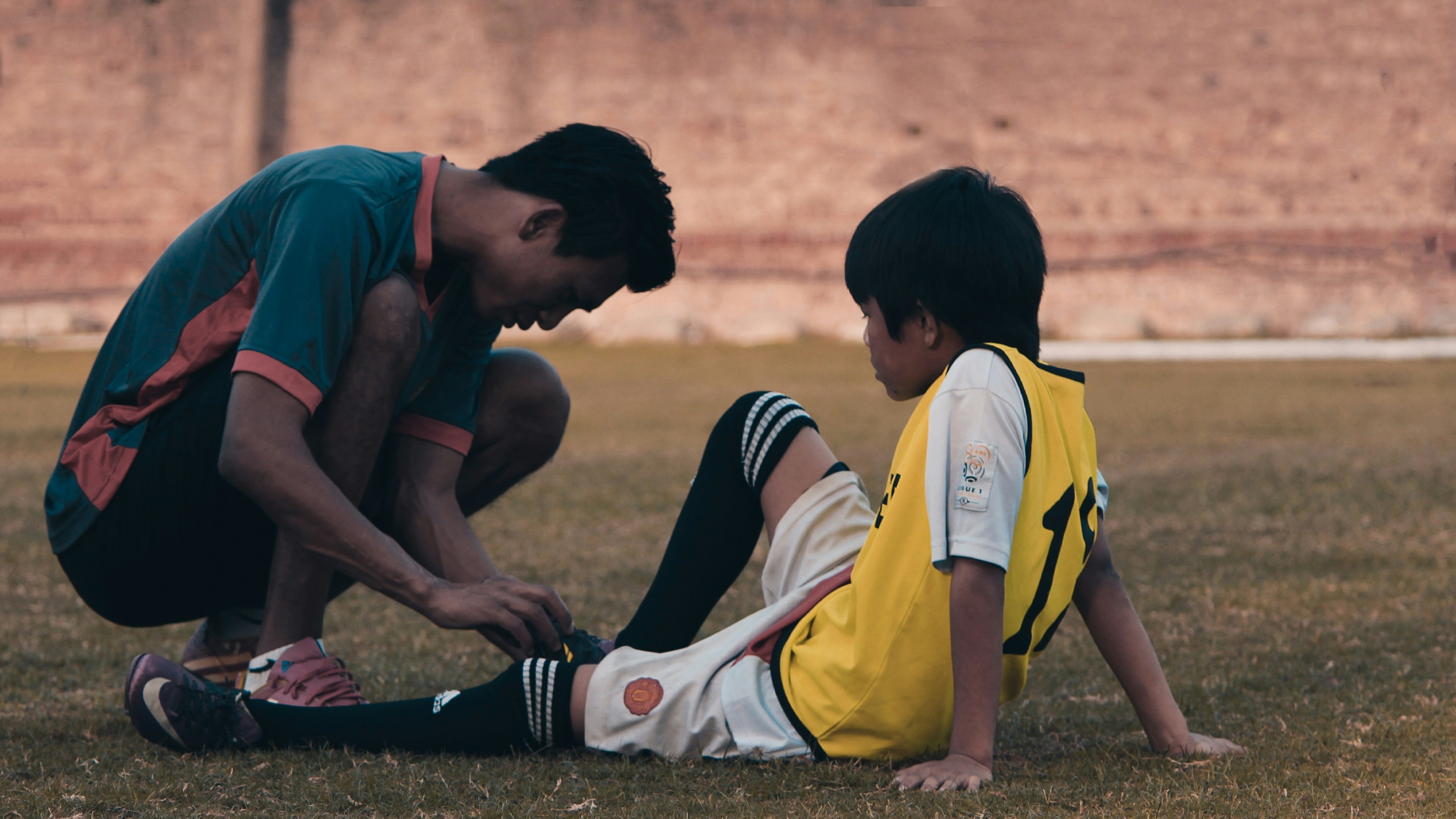
A twelve-year-old footballer points at a tender lump on the bone just below their kneecap. It hurts to kneel, hurts going downstairs, hurts most the day after a heavy session. Somebody says the word Osgood-Schlatter, and somebody else says the sentence that follows it everywhere: he'll grow out of it, just rest.
The first half of that sentence is more optimistic than the long-term data supports. The second half is contradicted by the best available intervention study.
What it is, and how common
Osgood-Schlatter disease is a traction-related injury at the tibial tuberosity, the bony attachment point of the patellar tendon just below the knee. In a growing athlete, that attachment sits on an active growth region, and repeated high-force pulling from the quadriceps through the patellar tendon irritates it.
A systematic review by Lucenti and colleagues, drawing on 16 included articles, puts the basic epidemiology as follows.1
On risk factors, the same review found support for muscular tightness — particularly of rectus femoris — alterations in the patellar tendon and extensor mechanism, repetitive sporting load and biomechanical stress, increased posterior tibial slope and external tibial torsion, and limited ankle dorsiflexion. Several factors commonly assumed to matter showed no significant predisposing effect across the studies examined, including BMI, growth rate and age at onset.1 The review's own framing is that the aetiology remains incompletely understood.
The practical reading is narrow but useful: of the factors with support, two are modifiable in a training programme — quadriceps tightness and ankle dorsiflexion range — and one is a coaching variable, which is how much high-force knee-extension loading a growing athlete absorbs each week.
The "grows out of it" claim, tested
The reassurance is standard because the bony prominence stops being painful for most people once the growth region closes. A Danish national cohort study asked what those people's knees are like as adults.
Researchers identified 1,281 patients diagnosed in secondary care between 1977 and 2020 and surveyed them; 400 responded and 397 were analysed.2 Among respondents:
The study also reported markedly elevated odds of associated knee conditions, most strikingly for patellar tendinopathy (jumper's knee), and elevated odds of meniscal injury in both sexes.2 The authors' conclusion is that Osgood-Schlatter is "not always as benign and self-limiting as previously thought."2
That finding needs its caveat stated plainly, because it is a large one. This cohort was drawn from patients diagnosed in secondary care — people whose knee pain was significant enough to reach a hospital specialist — and only 33% of those contacted responded. Both features bias the sample toward more severe and more memorable cases. The figures above are not the prognosis for every child with a sore knee. What they do establish is that a meaningful subgroup carries the problem into adulthood, which is enough to retire "they'll grow out of it" as a complete answer.
Rest is not the intervention
The default management has long been passive: stop the painful activity and wait. Rathleff and colleagues tested the alternative in a prospective study of 51 adolescents aged 10 to 14, half of them female, all with Osgood-Schlatter.3
The detail that frames everything else: participants reported a mean pain duration of 21 months at enrolment.3 Nearly two years of the wait-and-see approach had already been tried on these children before the study began.
The 12-week intervention had three components — education plus an "activity ladder" designed to manage patellar tendon loading against pain, progressive knee-strengthening exercise, and a graded return-to-sport pathway.3 The results:
Jumping performance improved too — 14% for distance and 19% for height — and KOOS subscores for Pain, Activities of Daily Living, Sport and Recreation, and Quality of Life all improved significantly.3 The authors position this as an alternative to the passive approaches so often prescribed.3
Their study design is a case series — level 4 evidence, no control group — so this is not proof that loading beats rest in a head-to-head sense. What it is, set against a mean of 21 months of prior symptoms, is a strong signal that the passive default is not working well enough to defend as a first choice.
What this changes in practice
Stop framing it as an injury to wait out. It is a load-tolerance problem at a growing attachment site. Load tolerance is trainable; waiting does not train it.
Modify activity rather than remove it. The intervention that worked used a graded ladder of activity keyed to pain, not an absence of activity. Total rest removes the stimulus that builds the tendon and the muscle around it, and the adolescent returns to the same sport with the same capacity that failed the first time.
Expect months, not weeks. Return to sport was 16% at twelve weeks and 69% at twelve months in the study above. Any timeline promised to a parent in weeks is being invented.
Address the modifiable risk factors alongside the symptoms. Quadriceps flexibility and ankle dorsiflexion have support as risk factors in the systematic review, and both respond to programming.
Take it seriously the first time. The long-term cohort's central message is that a subgroup does not recover cleanly. The cheapest moment to influence that is while the athlete is still twelve.
Where this evidence stops
The evidence base here is weaker than the confidence with which Osgood-Schlatter is usually discussed. The epidemiology review notes the aetiology is not fully understood. The long-term cohort is a secondary-care sample with a 33% response rate. The loading study is an uncontrolled case series of 51 adolescents. None of this supports a precise prognosis for an individual child, and a painful knee in a growing athlete should be assessed by a clinician rather than diagnosed from a blog post — several more serious conditions present similarly.
What the evidence does support is a change of default: from rest and reassurance, to managed load and a realistic timeline.
One caution on generalising it. Growing athletes get the same kind of traction injury at the back of the heel — calcaneal apophysitis, better known as Sever's disease — and the instinct is to carry this reasoning straight across. The evidence at the heel is thinner than it is at the knee, and it does not land in quite the same place. That one is worth reading on its own terms.
Sources
- Lucenti, L., Sapienza, M., Caldaci, A., et al. (2022). The etiology and risk factors of Osgood–Schlatter disease: a systematic review. Children (Basel), 9(6), 826. https://doi.org/10.3390/children9060826
- Krommes, K., et al. (2025). Long-term knee health in adults with a history of adolescent Osgood–Schlatter: a national cohort study of patients in secondary care in Denmark 1977–2020. Sports Medicine, 55(7), 1769–1781. https://doi.org/10.1007/s40279-025-02214-5
- Rathleff, M. S., Winiarski, L., Krommes, K., Graven-Nielsen, T., Hölmich, P., Olesen, J. L., Holden, S., & Thorborg, K. (2020). Activity modification and knee strengthening for Osgood-Schlatter disease: a prospective cohort study. Orthopaedic Journal of Sports Medicine, 8(4), 2325967120911106. https://doi.org/10.1177/2325967120911106
Want this applied to your own program, team, or school? Free 20-minute consult, no obligation.
Book a free consult →