
Research · Schools & PE
PE Class Is Supposed to Be 50% Movement. Research Says It Usually Isn't
Fifty percent. That's the specific, published threshold health authorities set for how much of a physical education lesson should be spent in moderate-to-vigorous physical activity (MVPA) — the intensity zone associated with real cardiovascular and health benefit, as opposed to standing in a line, listening to instructions, or walking between stations. It isn't a vague aspiration. It's a number researchers have been testing actual PE lessons against, using stopwatches, trained observers, and increasingly accelerometers, for well over a decade — and the result is one of the more consistently documented gaps in the youth physical activity literature.
That 50% figure sits on top of a broader daily target. The World Health Organization's 2020 guidelines on physical activity for children and adolescents aged 5–17 recommend an average of at least 60 minutes a day of MVPA across the week.1 WHO's guidelines are about total daily activity across every setting — home, transport, play, sport — and don't specify what share of a single school lesson should be active. School PE is nevertheless one of the settings public health bodies have paid the closest attention to, because it's one of the few places every child, not only the ones who already play sport, is required to be moving at the same time.
Where the 50% figure actually comes from
The more specific, lesson-level benchmark traces back to U.S. public health and physical education bodies rather than to WHO directly. The CDC's 2011 School Health Guidelines to Promote Healthy Eating and Physical Activity states that physical education instruction should engage students in MVPA for at least 50 percent of class time.2 SHAPE America — the U.S. professional body for physical educators — has since built that figure directly into its own guidance on what "appropriate instruction" looks like: teachers "should use instructional practices that engage students in moderate to vigorous physical activity for at least 50 percent of class time, promoting maximum physical activity during class."3 The same 50% figure is used by the UK's Association for Physical Education, which is why it functions as the standard comparison point in published measurement research on both sides of the Atlantic, not just a US-specific number.
For readers unfamiliar with the term, MVPA is usually explained with a simple talk test: light activity is intense enough to talk in full sentences or sing; moderate activity allows talking in short phrases but not singing; vigorous activity makes talking difficult at all.7 The 50% benchmark is about the moderate-to-vigorous band specifically — not simply being present, upright, and part of a game.
What decades of measurement find inside real PE lessons
Two of the more heavily cited efforts to answer that question directly are systematic reviews and meta-analyses from the same research group, one covering elementary-school lessons and one covering secondary school. The elementary-school review pooled 13 studies across nine countries and found MVPA levels ranging from as low as 11.4% to as high as 88.5% of lesson time depending on the study, with a meta-analytic pooled average — across the seven studies suitable for statistical combination — of 44.8%.4 The secondary-school review, covering 25 studies, found a similar shortfall against the same 50% target: a pooled average of 40.5% of lesson time in MVPA overall, made up of 48.6% in middle school and just 35.9% in high school.5
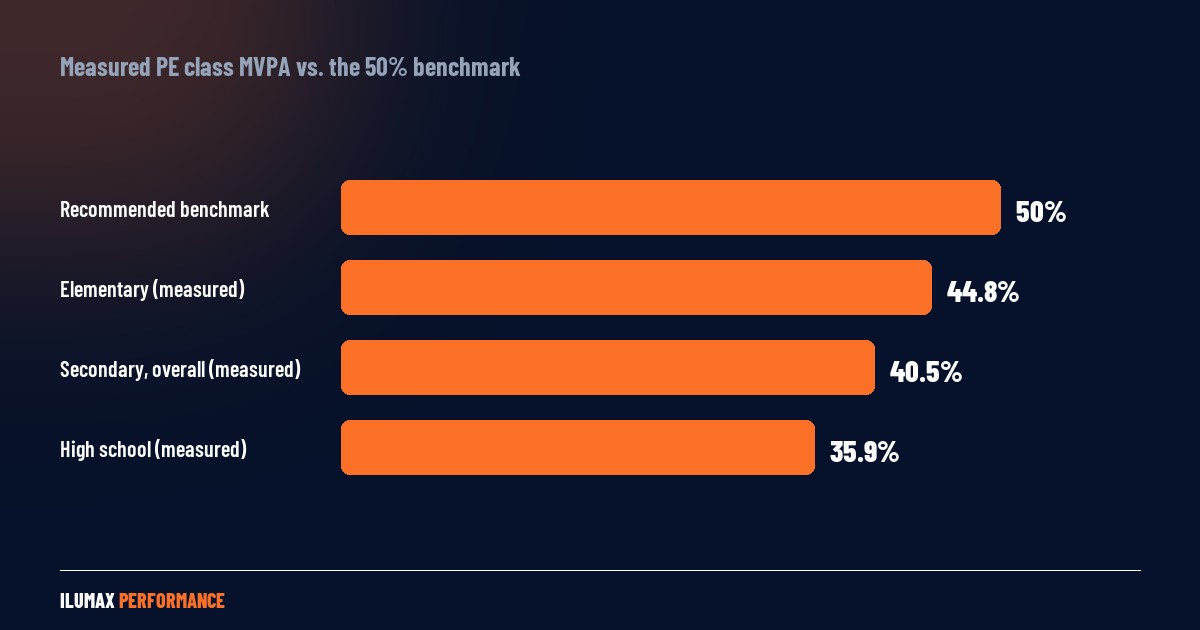
The MVPA benchmark set by CDC, SHAPE America, and the UK's AfPE, against pooled averages from the two largest systematic reviews of measured PE lessons.
Neither review is old news, and the shortfall hasn't closed with time. A 2024 systematic review and meta-analysis focused on gender differences in primary-school PE, searching literature published between 2013 and 2023 and pooling 19 studies covering more than 7,500 students, found mean MVPA of just 28.75% of lesson time for boys and 25.99% for girls6 — lower again than the earlier elementary pooled figure, and with a measurable, consistent gap between boys and girls inside the same lessons.
Why the same lesson can be reported as either 33% or 58% active
Part of the spread between individual studies is genuinely about the lesson — a badminton unit run to maximize activity time looks different from a queue-heavy softball unit covering the same clock time. But part of the spread is about the instrument used to measure the lesson, not the lesson itself. Within the elementary-school review, the studies that measured MVPA using accelerometers — devices worn on the body that record actual movement — averaged 32.6% of lesson time in MVPA. The studies that instead used systematic direct observation, a trained rater coding activity from the sideline, averaged 57.6%: nearly double.4
An observer's eye is a cruder instrument than an accelerometer: coding thirty children this precisely, in real time, tends to be generous about what counts as "moderate." That gap matters for anyone reading a single percentage off a study, a news article, or a school's own claim about how active its PE lessons are — the honest answer to "how active is this class" depends heavily on how the question was measured, and the more rigorous the measurement, the further below 50% the figure tends to land.
Underneath both the measurement gap and the age-related decline sit a handful of structural, well-documented reasons the missing minutes go missing in the first place:
- Transitions and instruction. Time spent changing activities, listening to explanations, or waiting for equipment doesn't register as MVPA no matter how well the lesson is otherwise run.
- Activity choice. Formats with a lot of standing-and-waiting structure produce lower measured MVPA than continuous-movement formats such as small-sided games or circuits covering the same time slot.
- Class size. Larger classes generally mean more waiting for a turn per student and less individual attention from the teacher — a structural constraint on active time that has nothing to do with curriculum content.
- Measurement itself. As shown above, the instrument used to record a lesson changes the reported answer by a wide margin, before anything about the lesson has actually changed.
"The proportion of lesson time spent in MVPA is typically below the US CDC and UK AfPE recommendation of 50% of PE lesson time."
What this looks like in Singapore
None of the reviews above were run in Singapore, and a search for a large-scale, nationally representative accelerometer study of MVPA inside Singapore school PE lessons did not turn one up in this research. What does exist, and is directly verifiable, is Singapore's own Physical Activity Guidelines (SPAG) — jointly published by Sport Singapore and the Health Promotion Board, most recently revised in 2022 — which set essentially the same daily target as WHO for school children and youths aged 7 to 17: an average of 60 minutes a day of moderate-to-vigorous activity across the week, accumulated across home, school, and community settings, with vigorous activity and muscle- and bone-strengthening exercise recommended at least three days a week on top of that.7 Like the WHO guidance it mirrors, SPAG names school as one of several settings where that daily activity should happen. It does not publish a PE-lesson-specific MVPA percentage the way the CDC and SHAPE America do — a national physical activity target, not a PE-instruction standard.
The closest available Singapore-specific measurement comes from a single 2021 study out of the National Institute of Education, which fitted accelerometers to 93 students (40 girls) across Primary 1, 4, and 6 during two PE lessons at one Singapore primary school. Averaged across the three grades, students spent 46.98% of the scheduled lesson period in MVPA — just under the 50% international benchmark — but 69.74% of the lesson's actual active portion, once time lost to changing, transitions, and instruction was excluded from the calculation.8 The gap between those two figures is itself the finding worth sitting with: once a lesson actually gets moving, measured intensity looks comfortably above the target. The shortfall against the 50%-of-scheduled-class-time benchmark is concentrated in the minutes before that point — getting a class from the changing room into formation and genuinely warm.
That's one school, three grade levels, two lessons, and 93 students — nowhere near enough to describe what a "typical" Singapore PE class achieves nationally, and it should be read as exactly that: a single data point, not a national figure. Extending the broader international pattern found in elementary-age reviews above to Singapore as a whole, without local data confirming it, would be extrapolation rather than evidence, and it's presented here as extrapolation for that reason, not as an established local finding.
What this means for PE program design
For a school evaluating its own PE program, the 50% figure is a genuinely useful audit question precisely because it's measurable in a way most curriculum quality isn't: does a given lesson, timed honestly rather than judged by impression, get most students into that intensity zone for at least half of the time on the timetable? The research above suggests the honest answer is usually no — and that the shortfall isn't primarily a matter of which sport is on the timetable. It's concentrated in transitions, instruction time, and the queuing built into unmodified traditional game formats: structural details a scheme of work can be redesigned around, rather than left to whichever choices an individual teacher happens to make on the day.
That's the same discipline behind PE Program Development on this site — measuring what a lesson actually delivers against a stated, evidence-based target, rather than assuming that time allocated on the timetable and time actually spent moving are the same thing. The research says they consistently aren't, by a margin now documented across thousands of lessons, multiple countries, and more than a decade of measurement.
Sources
- Bull FC, Al-Ansari SS, Biddle S, et al. "World Health Organization 2020 Guidelines on Physical Activity and Sedentary Behaviour." British Journal of Sports Medicine 54(24):1451–1462, 2020. pmc.ncbi.nlm.nih.gov/articles/PMC7719906.
- Centers for Disease Control and Prevention. "School Health Guidelines to Promote Healthy Eating and Physical Activity." MMWR Recommendations and Reports 60(RR-5):1–76, 2011. pubmed.ncbi.nlm.nih.gov/21918496.
- SHAPE America. "The Essential Components of Physical Education." Guidance Document. Reston, VA: Author, 2015. shapeamerica.org — Essential Components of Physical Education (PDF).
- Hollis JL, Williams AJ, Sutherland R, Campbell E, Nathan N, Wolfenden L, Morgan PJ, Lubans DR, Wiggers J. "A Systematic Review and Meta-Analysis of Moderate-to-Vigorous Physical Activity Levels in Elementary School Physical Education Lessons." Preventive Medicine 86:34–54, 2016. doi.org/10.1016/j.ypmed.2015.11.018.
- Hollis JL, Sutherland R, Williams AJ, Campbell E, Nathan N, Wolfenden L, Morgan PJ, Lubans DR, Gillham K, Wiggers J. "A Systematic Review and Meta-Analysis of Moderate-to-Vigorous Physical Activity Levels in Secondary School Physical Education Lessons." International Journal of Behavioral Nutrition and Physical Activity 14:52, 2017. pmc.ncbi.nlm.nih.gov/articles/PMC5402678.
- "Gender Differences in Students' Moderate to Vigorous Physical Activity Levels During Primary School Physical Education Lessons: A Systematic Review and Meta-Analysis." Journal of Teaching in Physical Education 44(2):233, 2024. journals.humankinetics.com/view/journals/jtpe/44/2/article-p233.
- Sport Singapore, Health Promotion Board. "Singapore Physical Activity Guidelines (SPAG) — Start Moving, Make Every Move Count." Revised Edition, 2022. activesgcircle.gov.sg — SPAG Guidebook (PDF).
- Jamaluddin NS, Kawabata M. "Physical Activity Levels in Physical Education Lessons at Singapore Primary School." ACPES Journal of Physical Education, Sport, and Health (AJPESH) 1(2), 2021. journal.unnes.ac.id/sju/index.php/ajpesh/article/view/52585.
Want this applied to your own program, team, or school? Free 20-minute consult, no obligation.
Book a free consult →