
Research · Schools & PE
What a Good School PE Program Actually Tracks (It's Not Just the Fitness Test)
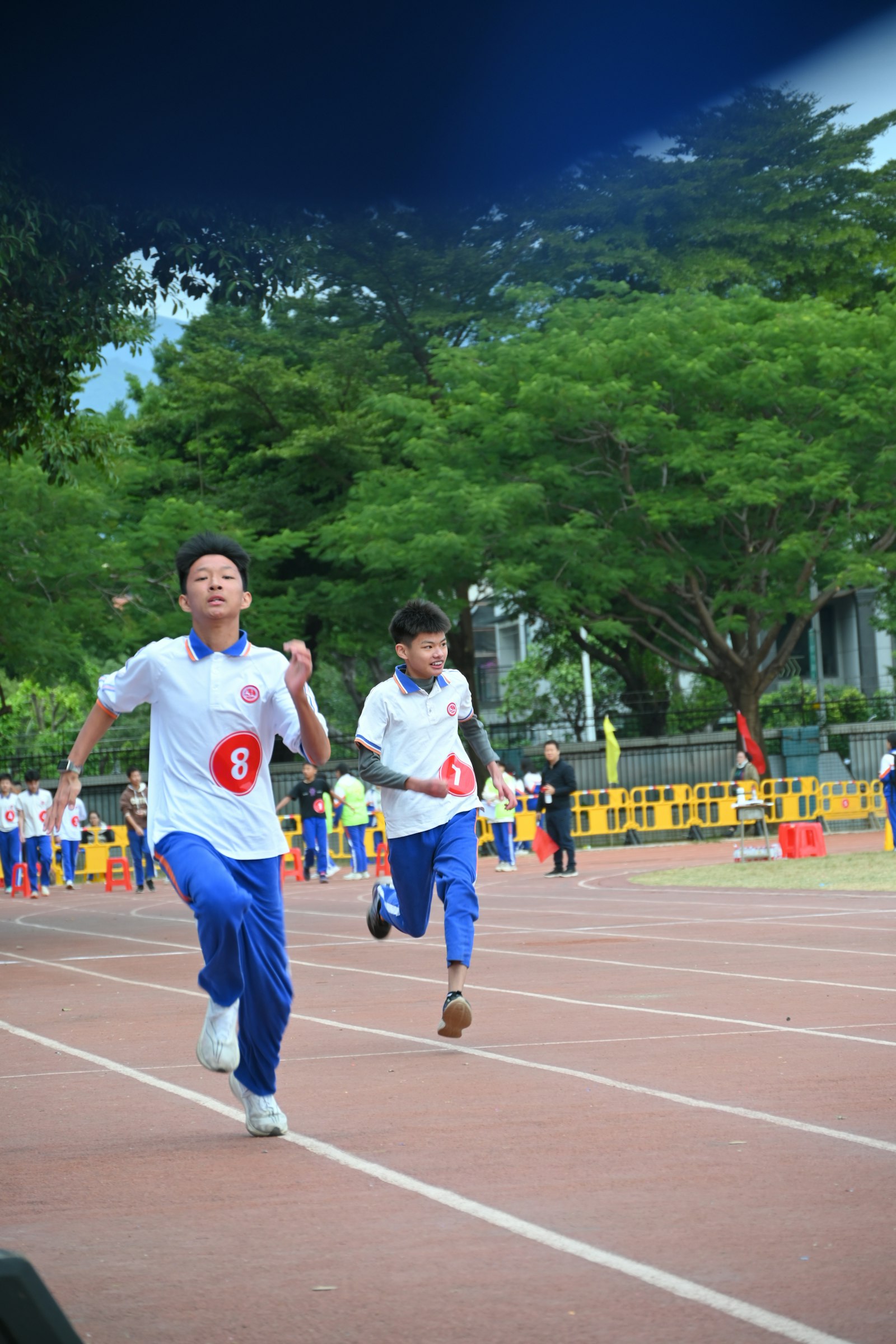
Ask a parent what their child's school PE program actually measures, and the answer is almost always the same: the NAPFA score. Pass, silver, gold — a single number, checked once or twice a year. It's the only piece of PE assessment most families ever see, so it quietly becomes the only piece they think exists.
It isn't. Both the U.S. national standards body for physical education and Singapore's own school-level assessment frameworks describe a PE program as something that tracks four separate things about a student, not one. A fitness score is a real, useful measurement — but on its own it's a quarter of the picture, not the whole of it.
What SHAPE America says a program should actually develop
SHAPE America — the U.S. professional body for physical and health educators — released a revised set of National Physical Education Standards in March 2024, consolidating what had been five standards into four.1 They describe what a "physically literate" student should be able to show, across four distinct domains:
- Standard 1 — Motor skills. A variety of movement skills, not just competence in one sport.
- Standard 2 — Movement and fitness knowledge. Understanding of movement concepts, tactics, and strategy — the "why," not just the doing.
- Standard 3 — Social skills through movement. Empathy, respect, and the ability to maintain relationships in a physical-activity setting.
- Standard 4 — Personal skills and valuing activity. Understanding why movement is personally beneficial, and choosing to engage in it — the standard most directly aimed at whether a student keeps being active once the class is over.
Notice what isn't a standard on its own: a raw fitness-test score. Fitness sits inside Standard 2, as one part of movement knowledge and concepts — not as the entire framework. A program built only around a periodic fitness test is, by SHAPE America's own structure, covering roughly one quarter of what it's supposed to be developing.
Singapore's own schools assess the same way — on paper, at least
This isn't a US-specific framing that doesn't map locally. Singapore school PE pages that publish how they implement the MOE-set syllabus describe an almost identical four-part structure. One secondary school's published assessment breakdown lists the components students are actually graded on: Sports Skills Performance (assessed via rubrics, typically in a game-based setting), Knowledge of the Games (theory questions), Behavioural Conduct (rubrics), and NAPFA scores.2 Another secondary school's curriculum page describes the same skills component in more detail — students assessed "in an authentic setting or game-like situation" across a run of sport modules, with ongoing formative feedback and peer assessment layered in alongside the affective, participation-based side of grading.3
One school's published grade weighting for Secondary 1–3 makes the split concrete:
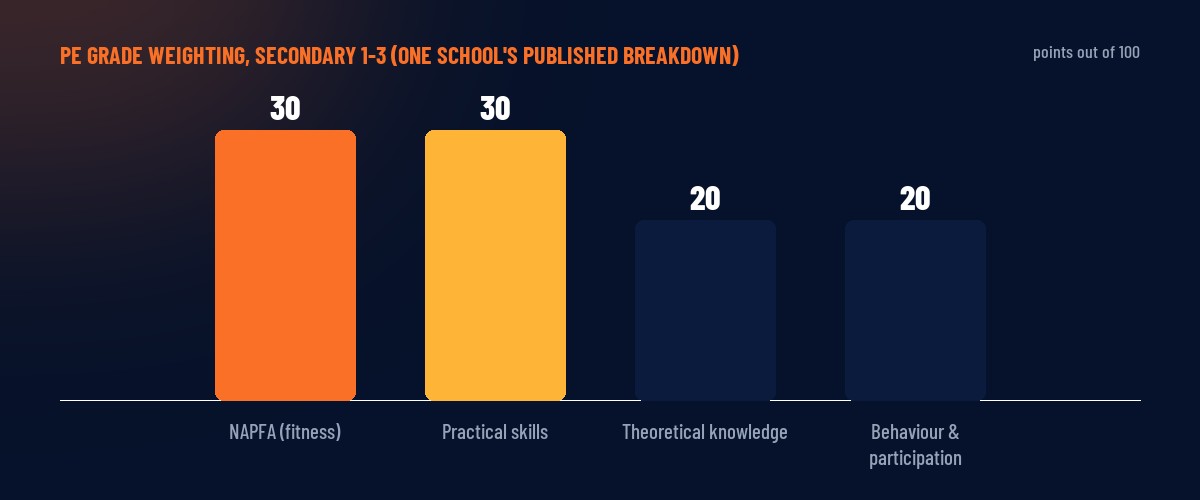
One school's published PE grade weighting, Secondary 1–3 — NAPFA is 30 of 100 points, not the whole grade.
By that published breakdown, fitness testing is the largest single line item — but it's still under a third of the total. Skill, knowledge, and behaviour together outweigh it two to one.
So why does NAPFA end up being the only thing anyone talks about?
Because it's the only piece built to stand alone. A school's own NAPFA page — the kind every Singapore secondary school publishes, listing the six stations (sit-ups, standing broad jump, sit-and-reach, inclined pull-ups, shuttle run, and the 1.6km or 2.4km run) and how each is scored — is, by design, a self-contained fitness-testing protocol document.4 It doesn't reference how that score sits alongside skill rubrics or theory checks, because that's not what it's for. It's the single most visible, most quantified, most easily-compared piece of PE assessment a family ever sees — a national award band, a number on a report card — so it's the piece that ends up standing in for the whole program in most parents' minds. The other three quarters of the framework exist; they're just harder to see from outside a classroom.
A fitness test score is one line item in a four-part assessment framework — not a stand-in for the other three.
What this means if you're evaluating — or building — a program
For a parent, the useful shift is asking a different question than "what's the NAPFA score." Ask whether skill is being assessed against a real rubric in game-like conditions, whether there's any check on whether a student actually understands the games and movement concepts being taught, and whether behaviour and participation are tracked systematically rather than left to a teacher's end-of-term impression. If a program can't answer those three, the fitness number is being asked to carry weight it was never designed to carry alone.
For a school building or refreshing a program — which is the actual work behind PE Program Development on this site — the same four-part discipline is the starting point, not an afterthought layered on later. A scheme of work that only produces a NAPFA result at the end of the year has, by SHAPE America's own standards and by the weighting Singapore schools already publish, built roughly a quarter of a PE program. The other three quarters are where a genuinely good one earns that description.
Sources
- SHAPE America. "National Physical Education Standards" (2024 revision — reduced from five standards to four). shapeamerica.org/standards/pe/new-pe-standards.
- Bedok South Secondary School. "Physical Education — Curriculum" (published PE assessment framework and Secondary 1–3 grade weighting). bedoksouthsec.moe.edu.sg.
- Crestian High School. "PE Curriculum" (skills assessment via game-based rubrics, formative feedback, affective-domain participation grading). sites.google.com/moe.edu.sg/prcss-curriculum.
- Catholic High School. "NAPFA" (test components and scoring, as a standalone protocol page). catholichigh.moe.edu.sg.
Want this applied to your own program, team, or school? Free 20-minute consult, no obligation.
Book a free consult →