
Research · Injury & Recovery
Pain-Free Is Not the Same as Ready: What Actually Predicts a Safe Return to Sport
The default test most athletes use to decide they're ready to return after injury is simple: does it still hurt? It's an intuitive check, and it's also measuring the wrong thing. Pain resolving tells you inflammation has settled and tissue has healed enough to stop protesting under normal load. It tells you almost nothing about whether the joint can absorb the specific, high, asymmetric forces the sport is about to ask of it again.
A 2021 study in the American Journal of Sports Medicine1 following ACL reconstruction patients through return-to-sport testing puts a number on exactly how large that gap is — and on what actually predicts whether an athlete gets hurt again.
What a real return-to-sport test battery checks
The criteria used weren't a single pass/fail moment. Athletes were assessed on the IKDC 2000 knee function score (needing ≥85%), a battery of single-leg hop tests measured as Limb Symmetry Index (LSI, comparing the injured limb to the healthy one — needing ≥85%, 90% for higher competitive levels), and isokinetic strength testing of the knee extensors. Passing meant clearing all three, not just feeling ready.
The reinjury numbers
This is the finding that should change how "ready" gets decided.
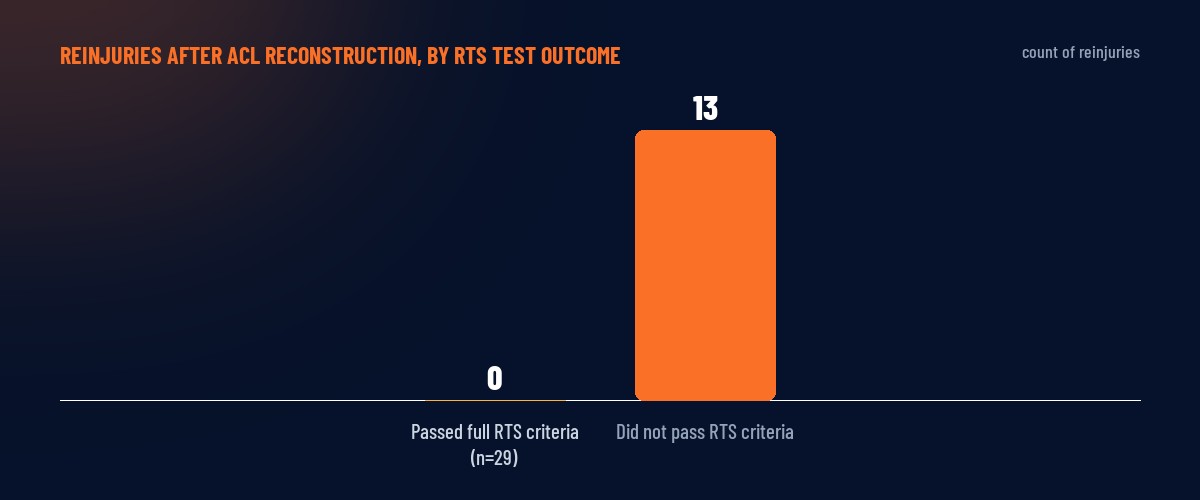
Reinjuries after ACL reconstruction, by return-to-sport test outcome — Faleide et al., 2021.
Zero reinjuries in the group that passed objective testing, against a real reinjury rate in the group that didn't, is about as direct a signal as sports-medicine outcome data gets.
The part pain-based self-assessment misses entirely
The study also measured psychological readiness directly, using the ACL-RSI — a 12-question scale covering confidence, emotion, and fear of reinjury around returning to sport. It turned out to predict outcomes that the physical tests alone did not: "age and psychological readiness displayed a predictive ability for return to preinjury level of sports, while conventional RTS tests did not." Each one-point increase in ACL-RSI score corresponded to a 3% increase in the likelihood of a successful return.
Fourteen patients in the study declined return-to-sport testing altogether, citing pain or a feeling of instability. Their ACL-RSI scores averaged 35, against 54 for the group that went ahead with testing — a real, measurable gap in psychological readiness, in people who may well have already been technically "pain-free" enough by conventional standards to consider going back. Physical capacity and psychological readiness are, in the authors' own framing, distinct and separate constructs. Clearing one says nothing reliable about the other.
Pain resolving is a necessary condition for return to sport. On its own, the evidence says it is nowhere near a sufficient one.
What this changes about how "ready" gets decided
A return-to-sport decision built on objective testing — strength symmetry, hop performance, and a real measure of psychological readiness rather than pain alone — isn't excess caution. Given a reinjury rate of zero in the group that cleared the full battery, it's the difference between an athlete going back once and going back for good.
Sources
- Faleide AGH, Magnussen LH, Strand T, Bogen BE, Moe-Nilssen R, Mo IF, Vervaat W, Inderhaug E. "Return to Sport After Anterior Cruciate Ligament Reconstruction: Psychological Readiness, Return-to-Sport Testing, and Injury Risk." The American Journal of Sports Medicine 49(5):1236–1243, 2021. DOI: 10.1177/0363546521991924.
Want this applied to your own program, team, or school? Free 20-minute consult, no obligation.
Book a free consult →