
Research · Strength & Power
Single-Leg or Double-Leg? What the Comparative Research Actually Shows About Transfer to Sport
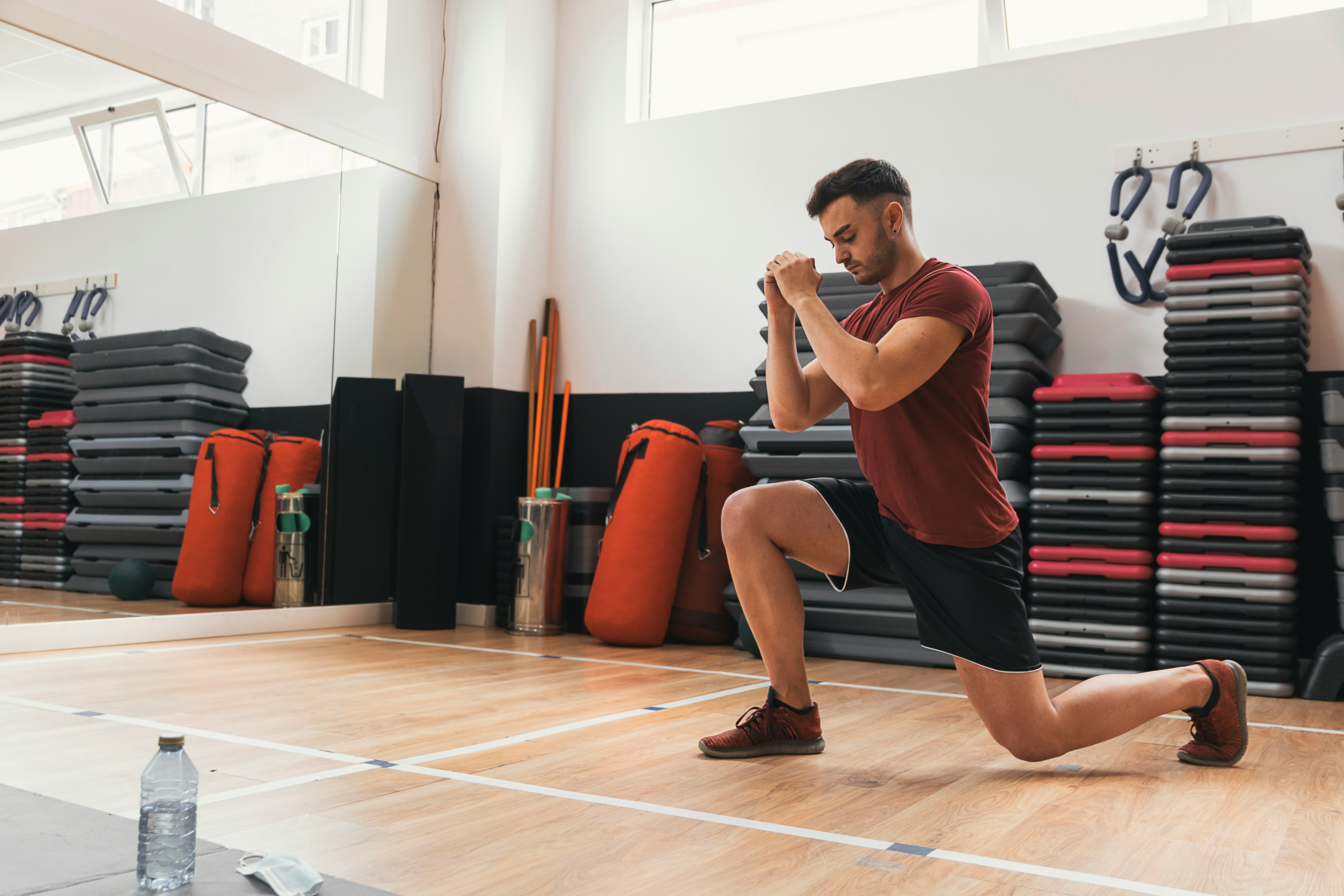
Ask five strength coaches whether a team-sport athlete should be squatting on two legs or one, and the room usually splits along a predictable line. One camp points out that almost nothing that decides a match — a sprint, a cut, a jump off one leg to head a ball or contest a rebound — actually happens on two feet at once, so training should mirror that. The other camp points at a bar loaded for a back squat and argues that's still the most efficient way to build the raw strength everything else gets built on. Both sides tend to invoke the "bilateral deficit" at some point, often to support opposite conclusions. It's worth checking what the actual comparative research — studies that put unilateral and bilateral training head-to-head in real athletes, not the theory built around them — actually found.
What the bilateral deficit actually is
The bilateral deficit is a specific, measurable phenomenon: a muscle group produces less force acting together with its opposite-side partner than the two sides produce when tested separately and summed. A comprehensive 2016 review in the European Journal of Applied Physiology, led by Jakob Škarabot, pulled together the accumulated evidence on where the deficit comes from and how consistent it actually is.1 Three findings from that review matter for programming. First, the deficit isn't fixed in size — it shows up more consistently in dynamic, ballistic movements than in static contractions, and how much postural stabilization a task demands changes its magnitude. Second, it doesn't have one single cause: slow, controlled tasks point toward genuine higher-order neural inhibition, while fast, explosive actions look more like a mechanical story instead — differences in how quickly each limb's muscle is shortening, and where it sits on its own force-velocity curve. Third, and most relevant here, the deficit itself responds to training. Programs built around bilateral lifting tend to shrink it. Programs built around unilateral lifting tend to leave it unchanged, or widen it.
What that third finding means in practice: the bilateral deficit isn't a fixed flaw waiting to be corrected. It behaves more like a training-specific fingerprint — a readout of which movement pattern the nervous system has actually been asked to get good at.
It's also not a universal property of the human body that shows up identically everywhere. The literature compiled in that same review is inconsistent on whether every lower-body exercise even produces one — some multi-joint, compound movements show a reliable deficit while more isolated, single-joint tasks don't always show one at all. That inconsistency is itself a clue that the deficit is downstream of how a specific movement is coordinated, not some fixed ceiling on how much force two limbs can jointly produce.
Does a bigger deficit even predict worse performance?
If the deficit genuinely represented lost, wasted force-production capacity, a bigger one should predict worse athletic output. A 2022 study in Frontiers in Physiology tested that directly in 47 national-division male volleyball players, measuring the deficit across several countermovement-jump metrics and checking how it related to sprint and change-of-direction performance.2 The size of the deficit varied enormously depending on what was actually measured — a modest −5% for jump height, a much larger −19% for peak power, and as much as −31% for force impulse during the jump's propulsion phase. If a bigger deficit meant a bigger problem, it should have tracked with slower sprinting. It did the opposite: a larger deficit correlated with faster 10m, 15m, and 25m sprint times, and with a higher approach-jump height, not a lower one.
The likely explanation isn't that losing bilateral force output makes an athlete faster. It's that the same neuromuscular profile that produces a large bilateral deficit — a nervous system specialized for producing force through one limb at a time, at speed — is the same profile that makes an athlete good at single-leg, high-velocity actions in the first place. Chasing a smaller bilateral deficit as a training goal in its own right isn't obviously chasing anything useful.
What happens when the two approaches are actually compared
Set the deficit itself aside and look at what training studies find when unilateral and bilateral programs are run head-to-head, and a far more consistent pattern shows up — one that keeps repeating across independently conducted reviews.
A 2023 meta-analysis in Frontiers in Physiology pooled 28 studies and 651 athletes comparing the two approaches across strength, jump, sprint, and change-of-direction outcomes.3 Unilateral training produced a large, statistically significant improvement in single-leg strength testing and a moderate, significant improvement in single-leg jump performance. Neither improvement reached the same significance when the same programs were tested on bilateral measures instead. The same review flagged a practical cost most of the theoretical debate skips entirely: matching sets and reps between the two approaches, unilateral training simply takes longer to complete — the authors note coaches "should reasonably arrange unilateral training time, because unilateral training takes twice as long as bilateral training" in a typical session.
A 2025 systematic review in Sports Medicine, run by a separate research group working from a smaller, more tightly controlled set of nine trials, tested the same comparison from a different angle: muscle growth alongside strength.4 Hypertrophy came out identical between the two conditions — training unilaterally builds just as much muscle as training bilaterally. Strength did not come out identical: bilateral training produced the bigger gain when strength was tested bilaterally, and unilateral training produced the bigger gain when it was tested unilaterally. Two independent reviews, different studies, different authors, same underlying rule: strength adaptations transfer along the same movement pattern used to build them. Hypertrophy doesn't seem to care which pattern was used at all.
The team-sport-specific evidence
The reviews above pool athletes from any background. What matters more for a basketball, soccer, rugby, or hockey athlete is whether the same pattern holds inside team sports specifically — and a 2026 systematic review and meta-analysis in Biology of Sport, built around exactly that population, is the most direct answer currently available. It pooled 15 randomized controlled trials and 355 team-sport athletes across basketball, soccer, rugby, and hockey.5 Unilateral training produced a moderate-to-large advantage over bilateral training for unilateral strength (g = 0.68, p = 0.007), unilateral countermovement jump (g = 0.37, p = 0.025), and unilateral horizontal jump (g = 0.45, p = 0.03). But across overall strength, bilateral strength, bilateral jump, reactive strength index, sprint, and agility, no reliable advantage emerged for either approach. The one exception ran the other way: in the basketball-specific subset, unilateral training actually outperformed bilateral training on both agility (g = −0.77, p = 0.04) and sprint.
A separate 2026 Frontiers in Physiology meta-analysis, restricted to nine trials and 163 male basketball players specifically, reached the same shape of result: unilateral training produced a significant advantage in single-leg countermovement-jump height and in a lateral cutting (V-cut) test, while bilateral jump, reactive strength index, and both 5m and 20m sprint times showed no difference between the two approaches.6
What real team-sport training trials found, exercise by exercise
Meta-analyses answer "on average, across many studies." Two individual randomized controlled trials, run specifically to test transfer in real team-sport squads, are worth knowing by name — because both complicate the simple version of this story.
A rugby squat-versus-step-up trial
An 18-week trial published in the Journal of Strength and Conditioning Research put 33 developmental rugby players through a volume-load-matched program built around either the back squat (bilateral) or the step-up (unilateral).7 Both groups got stronger on the exercise they didn't train — real transfer ran in both directions, not only from bilateral to unilateral. Both groups improved 20m sprint performance by a similar amount. The genuinely counterintuitive finding: change-of-direction performance, the exact outcome the "sport is played on one leg" argument would predict should favor the unilateral group, actually showed better transfer from the bilateral squat than from the unilateral step-up.
An elite youth soccer trial
A second trial, in elite youth soccer players aged 17–18, ran a shorter six-week bilateral-versus-unilateral-biased program and measured a wider battery of outcomes.8 The bilateral group came out ahead on squat strength, broad jump, and both 10m and 30m sprint times. The unilateral group came out ahead on single-leg jump, single-leg strength, and the 505 change-of-direction test on one leg. Specificity held in both directions — each program built what it directly trained — but which outcome came out "ahead" depended entirely on which single test was being read, and a program built around only one approach left real, measurable performance qualities undeveloped on the other side of that split.
So which should team-sport athletes actually prioritize?
Put the eight studies together and the pattern is more specific than either side of the original coaching-room argument: the outcome a program trains is the outcome it improves, and that rule applies almost mechanically. Unilateral training reliably builds unilateral strength and unilateral jump capacity better than bilateral training does. Bilateral training reliably builds bilateral strength at least as well, and in most comparisons better. Neither approach has shown an advantage for hypertrophy. And for the two qualities coaches most want to move — sprinting and change of direction — the pooled team-sport evidence found no consistent advantage for either method used alone, with the rugby squat-to-COD finding actively working against the assumption that unilateral training must be the more specific choice for a cutting sport.
"Training should avoid overreliance on a single method and instead combine UT and BT based on the athlete's training status and performance objectives." — Wu et al., Biology of Sport, 2026
That's a more useful takeaway than declaring a winner, because the evidence itself doesn't declare one. Two failure modes show up clearly across these eight studies:
- A program built exclusively around bilateral compound lifts leaves a real, measurable unilateral-strength and unilateral-jump adaptation on the table — one the team-sport-specific data ties directly to basketball agility and sprint performance.
- A program built exclusively around single-leg work leaves the bilateral-strength gain, and the squat-to-change-of-direction transfer the rugby trial found, on the table instead — with no compensating advantage in hypertrophy to show for the trade.
Both mistakes are avoidable with the same fix: load both patterns rather than picking a side. In practice that means the back squat, deadlift, and hip thrust still earn their place as the base-building, time-efficient bilateral lifts the evidence says they are — and split squats, single-leg RDLs, lateral lunges, and step-ups earn theirs as the exercises that build the specific single-leg strength and power the team-sport data ties to jumping, cutting, and sprinting. The proportion between the two is what should shift, set by what an individual athlete's own testing — sport-specific movement demands, training age, and any existing limb asymmetry — actually shows they need more of, rather than by which side of the coaching-room debate happens to be more fashionable this year.
Sources
- Škarabot J, Cronin N, Strojnik V, Avela J. "Bilateral deficit in maximal force production." European Journal of Applied Physiology 116(11-12):2057–2084, 2016. pubmed.ncbi.nlm.nih.gov/27582260.
- Pleša J, Kozinc Ž, Šarabon N. "Bilateral Deficit in Countermovement Jump and Its Influence on Linear Sprinting, Jumping, and Change of Direction Ability in Volleyball Players." Frontiers in Physiology 13:768906, 2022. DOI: 10.3389/fphys.2022.768906.
- Zhang W, Chen X, Xu K, Xie H, Li D, Ding S, Sun J. "Effect of unilateral training and bilateral training on physical performance: A meta-analysis." Frontiers in Physiology 14:1128250, 2023. DOI: 10.3389/fphys.2023.1128250.
- Kassiano W, Nunes JP, Costa B, Ribeiro AS, Loenneke JP, Cyrino ES. "Comparison of Muscle Growth and Dynamic Strength Adaptations Induced by Unilateral and Bilateral Resistance Training: A Systematic Review and Meta-analysis." Sports Medicine 55(4):923–936, 2025. pubmed.ncbi.nlm.nih.gov/39794667.
- Wu B, Yin M, Song Z, Tao M, Xu K, Nassis GP, Bishop C, Girard O. "Effects of unilateral and bilateral training on performance in team sports athletes: a systematic review and meta-analysis." Biology of Sport 43:1019–1049, 2026. DOI: 10.5114/biolsport.2026.159564.
- Zhang Z, Shu F, Guo H, Zhang J, Gao J. "Unilateral versus bilateral resistance training for explosive jump performance, linear sprint speed, and change-of-direction ability in male basketball players: a systematic review and meta-analysis." Frontiers in Physiology, 2026. DOI: 10.3389/fphys.2026.1798477.
- Appleby BB, Cormack SJ, Newton RU. "Specificity and Transfer of Lower-Body Strength: Influence of Bilateral or Unilateral Lower-Body Resistance Training." Journal of Strength and Conditioning Research 33(2):318–326, 2019. pubmed.ncbi.nlm.nih.gov/30688873.
- Stern D, Gonzalo-Skok O, Loturco I, Turner A, Bishop C. "A Comparison of Bilateral vs. Unilateral-Biased Strength and Power Training Interventions on Measures of Physical Performance in Elite Youth Soccer Players." Journal of Strength and Conditioning Research 34(8):2105–2111, 2020. pubmed.ncbi.nlm.nih.gov/32541618.
Want this applied to your own program, team, or school? Free 20-minute consult, no obligation.
Book a free consult →