
Research · Youth Development
The 10,000-Hour Rule Is Wrong — What the Research Actually Says About Young Athletes
Two beliefs show up in almost every conversation I have with parents about their kid's training. First: earlier specialization in one sport gives a real head start. Second: somewhere around 10,000 hours of practice, mastery arrives.
Both are wrong enough that the sport science field has an official position statement addressing them directly. The NSCA's 2016 Position Statement on Long-Term Athletic Development — a consensus paper from nine researchers across pediatric exercise science and sports medicine, published in the Journal of Strength and Conditioning Research1 — is one of the most-cited documents in youth training, and it's worth actually reading rather than paraphrasing secondhand.
Myth 1: The 10,000-hour rule
The number comes from research on expert musicians, not athletes — a study of the deliberate practice required to reach mastery in a skill. It was never a sports-science finding. The position statement notes that a later editorial revisited the original work and found it had been misinterpreted: the seminal data was more reflective of roughly 5,000 hours for actual performers, not 10,000.
More importantly, the paper is explicit that practitioners "should not subscribe to the hypothetical 10,000-hour rule, but instead value the quality of practice rather than a specific quantity of practice." Counting hours is the wrong unit of analysis. What happens inside those hours — technical correction, appropriate load, recovery — is what the evidence actually tracks.
Myth 2: Specializing early is the fast path
This is the one with the most direct evidence against it, and the numbers are specific enough to be uncomfortable.
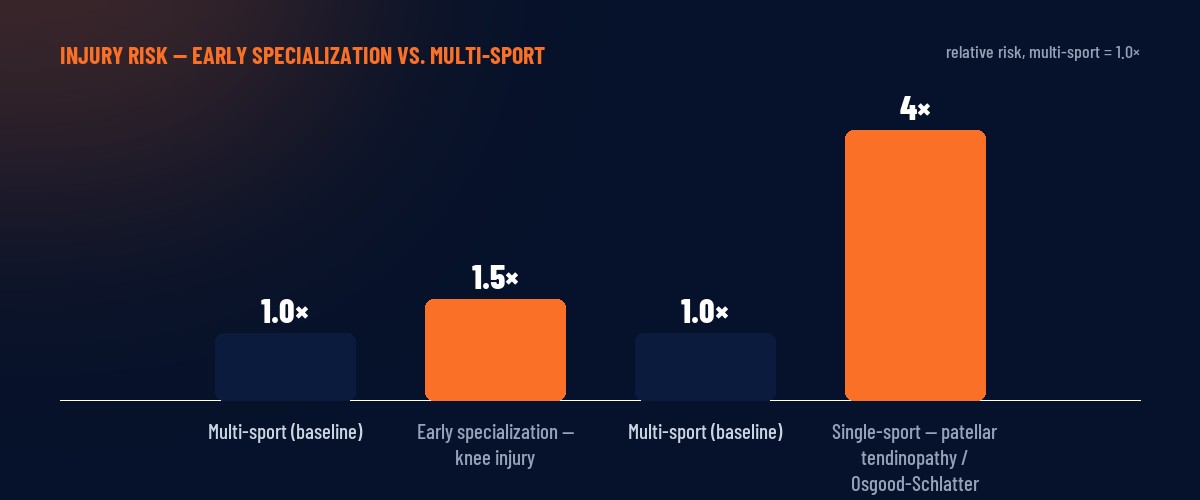
Relative injury risk — early single-sport specialization vs. multi-sport participation, per the NSCA position statement's cited data.
The position statement also cites Jayanthi et al.'s finding that injury risk rises sharply once a young athlete's weekly hours of sport-specific practice exceed their age in years — or once the ratio of organised sport to free, unstructured play passes roughly 2:1.
None of this is really about injuries alone, either. Early specialization is also associated with a "blunted" motor skill portfolio, a reduced ceiling on adult performance, and a higher rate of burnout and dropout — the opposite of what a parent chasing a head start is actually trying to buy.
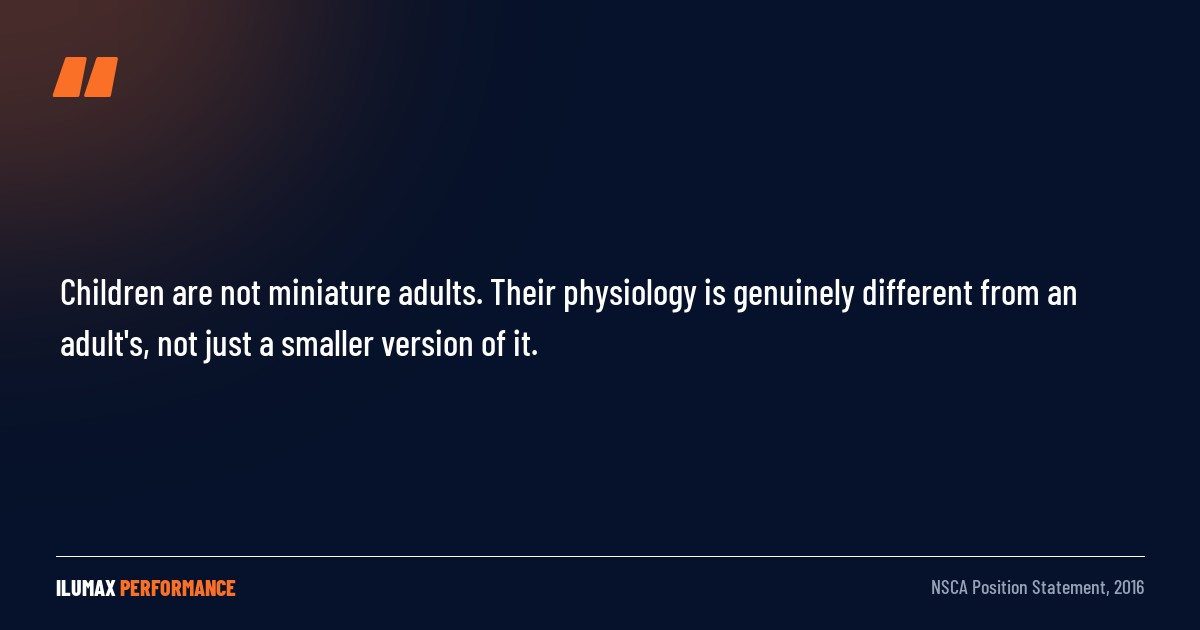
"Children are not miniature adults." Their physiology — muscle structure, activation patterns, force production, even how they recover from high-intensity exercise — is genuinely different from an adult's, not just a smaller version of it. Training programs that ignore that difference aren't being efficient. They're guessing.
What the evidence actually recommends: sampling
The alternative the paper describes is "sampling" — playing multiple sports through the school-age years rather than committing to one early. This isn't a compromise that trades performance for safety. Retrospective data across a range of sports found that athletes who played three or more sports between ages 11 and 15 were more likely to reach national level than athletes who specialized earlier and topped out at club level by 16–18.
For sports measured in centimetres, grams, or seconds — track and field, swimming, weightlifting — later specialization and lower volumes of sport-specific practice in childhood are significant predictors of elite adult performance, not obstacles to it.
There's a developmental logic behind this too. A meta-analytical review of 34 training studies found that pre- and early-pubertal children achieve resistance-training-induced motor skill gains roughly 50% greater than adolescents achieve from the same training. The early years are disproportionately good for building the broad movement vocabulary — coordination, balance, force production, force attenuation — that every sport eventually draws on. Locking into one sport's movement pattern early trades that window away.
What this looks like in practice
The position statement lists ten pillars for long-term athletic development. The ones that change how a program should actually be built:
- Individualised and non-linear. Two kids of the same chronological age can be years apart in biological maturity. A program built around birth year rather than developmental stage is measuring the wrong thing.
- Motor skill and strength together, from early childhood — not strength training deferred until adolescence "when it's safe." The paper is direct that well-supervised resistance training in childhood does not impair growth, does not delay puberty, and does not restrict eventual height. What it does is build the foundation everything else sits on.
- Systematic monitoring. Practitioners should use assessment tools to track where an athlete actually is, not assume it from age or sport.
- Qualified professionals. The paper is specific that this means someone with training in pediatric exercise science, not general adult coaching experience applied downward.
This is the model behind the testing-first approach on this site — a baseline before a program is written, not a template applied and hoped for. For a young athlete, "the same programme as the adults, just lighter" fails for reasons that have nothing to do with effort and everything to do with physiology the template never accounted for.
Sources
- Lloyd RS, Cronin JB, Faigenbaum AD, Haff GG, Howard R, Kraemer WJ, Micheli LJ, Myer GD, Oliver JL. "National Strength and Conditioning Association Position Statement on Long-Term Athletic Development." Journal of Strength and Conditioning Research 30(6):1491–1509, 2016. Full position statement (PDF, NSCA).
Want this applied to your own program, team, or school? Free 20-minute consult, no obligation.
Book a free consult →